英语
英语 俄语
俄语 西班牙语
西班牙语 德语
德语
Home / Author / Yutong Cai — Customer Solutions Specialist / Industrial Forward Tilting Dryer: High-Capacity Drying for Modern Laundry Operations

Kingstar is your trusted partner for industrial and commercial laundry equipment. We specialized in the R&D and manufacturing of high-end industrial washers, commercial washers and dryers. Meanwhile, we provide global clients with comprehensive planning, layout workflow design, and software-hardware integration services for smart laundry plants.
Yutong Cai — Customer Solutions Specialist
Oct 16,2026
Industrial Forward Tilting Dryer: High-Capacity Drying for Modern Laundry Operations
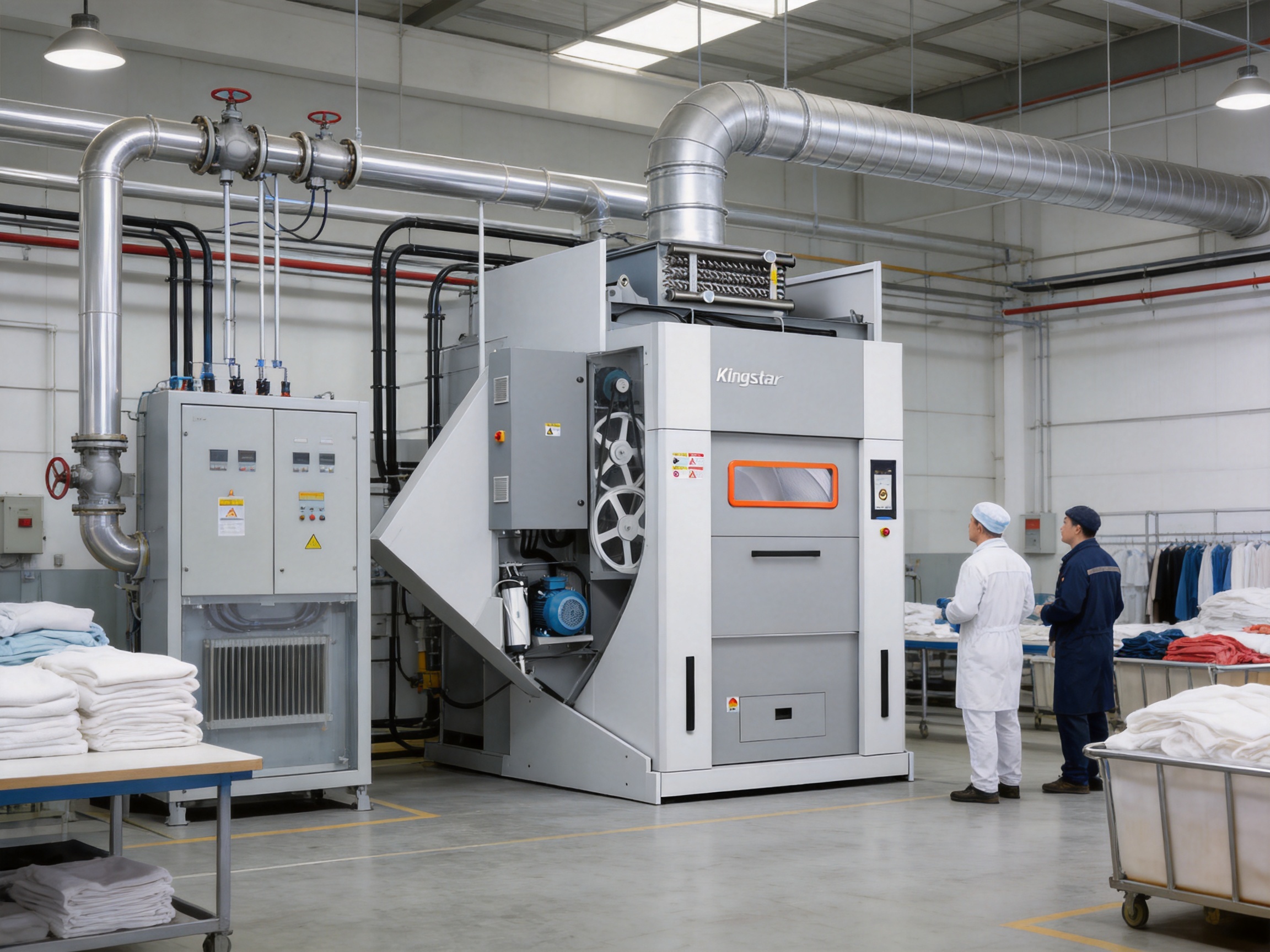
Industrial laundry facilities require drying equipment that can combine capacity, speed, energy awareness, durability, and safe handling in one dependable system. Hotels, hospitals, self-service laundries, uniform rental companies, textile processors, and institutional laundries often process hundreds or thousands of kilograms of linen and garments every day. In these environments, a dryer is not simply a finishing machine. It is a central production asset that directly influences throughput, labor requirements, operating costs, textile quality, and customer satisfaction.
The Industrial Forward Tilting Dryer is designed for these demanding applications. With a rated capacity of 100 kilograms, a 2,000-liter drum volume, intelligent humidity control, multiple heating options, and a front tilt discharge system, it provides a practical solution for high-volume laundry processing. Its 10.1-inch touchscreen controller supports up to 99 editable automatic programs, allowing operators to configure drying cycles for towels, bed linen, uniforms, hospital textiles, and other fabric categories.
Unlike conventional dryers that require operators to manually reach into a deep drum to remove heavy loads, this model uses a forward tilting discharge design. The drum can move toward the front unloading area, helping reduce handling time and physical strain. This feature is particularly valuable when processing dense, wet textiles that are difficult to remove manually after a full cycle.
The dryer also offers steam, electric, and gas heating configurations. This flexibility allows laundry operators to select a heating source that matches their local energy infrastructure, installation conditions, operating budget, and sustainability objectives. Combined with a high-power heating system, insulated outer cylinder, 304 stainless steel inner drum, and industrial control components, the machine is designed to support reliable production over extended operating periods.
1. The Role of High-Capacity Drying in Industrial Laundry
Drying is one of the most energy-intensive stages in a professional laundry. It must remove a large amount of moisture while protecting textile fibers, maintaining consistent final moisture content, and preparing linen for folding, ironing, storage, or immediate reuse. Any weakness in the drying process can create bottlenecks throughout the facility.
A machine with insufficient capacity may require too many cycles, increasing labor and utility consumption. A dryer with poor airflow may leave damp areas in towels and linen, forcing operators to repeat the cycle. Excessive heat or uncontrolled drying time can cause shrinkage, color deterioration, fabric weakening, and unnecessary energy consumption. Difficult unloading can also reduce productivity, especially when workers must repeatedly lift heavy and compacted loads.
The Industrial Forward Tilting Dryer addresses these operational concerns through a combination of large capacity, controlled airflow, programmable operation, humidity management, and assisted unloading. It is engineered for facilities that need to process substantial volumes while maintaining a consistent workflow from washing to drying and finishing.
Its 100-kilogram capacity is suitable for large commercial and institutional laundry operations. The 1:20 volume load ratio corresponds to a drum volume of approximately 2,000 liters, providing adequate space for textiles to tumble and separate during drying. Proper tumbling improves exposure to heated air and helps promote more even moisture removal throughout the load.
2. Product Overview and Main Operating Concept
The machine operates by introducing heated air into a rotating perforated drum while moisture-laden air is removed through the exhaust system. The drum rotates to lift, separate, and redistribute the textiles. This continuous movement helps expose wet fabric surfaces to the heated airflow, improving drying uniformity.
The drum has a diameter of 1,460 millimeters and a depth of 1,200 millimeters. Its inner perforated sheet is made with a specified thickness of 1.2 millimeters and perforation openings of 8 millimeters. These dimensions are intended to support airflow while providing a robust working surface for heavy commercial loads.
Moisture is discharged through an exhaust outlet with a diameter of 325 millimeters. The specified exhaust airflow is 106 cubic meters per minute. Effective exhaust design is essential because drying performance depends not only on heat input but also on the efficient removal of humid air. If moisture remains trapped inside the dryer, the cycle may become slower and less efficient.
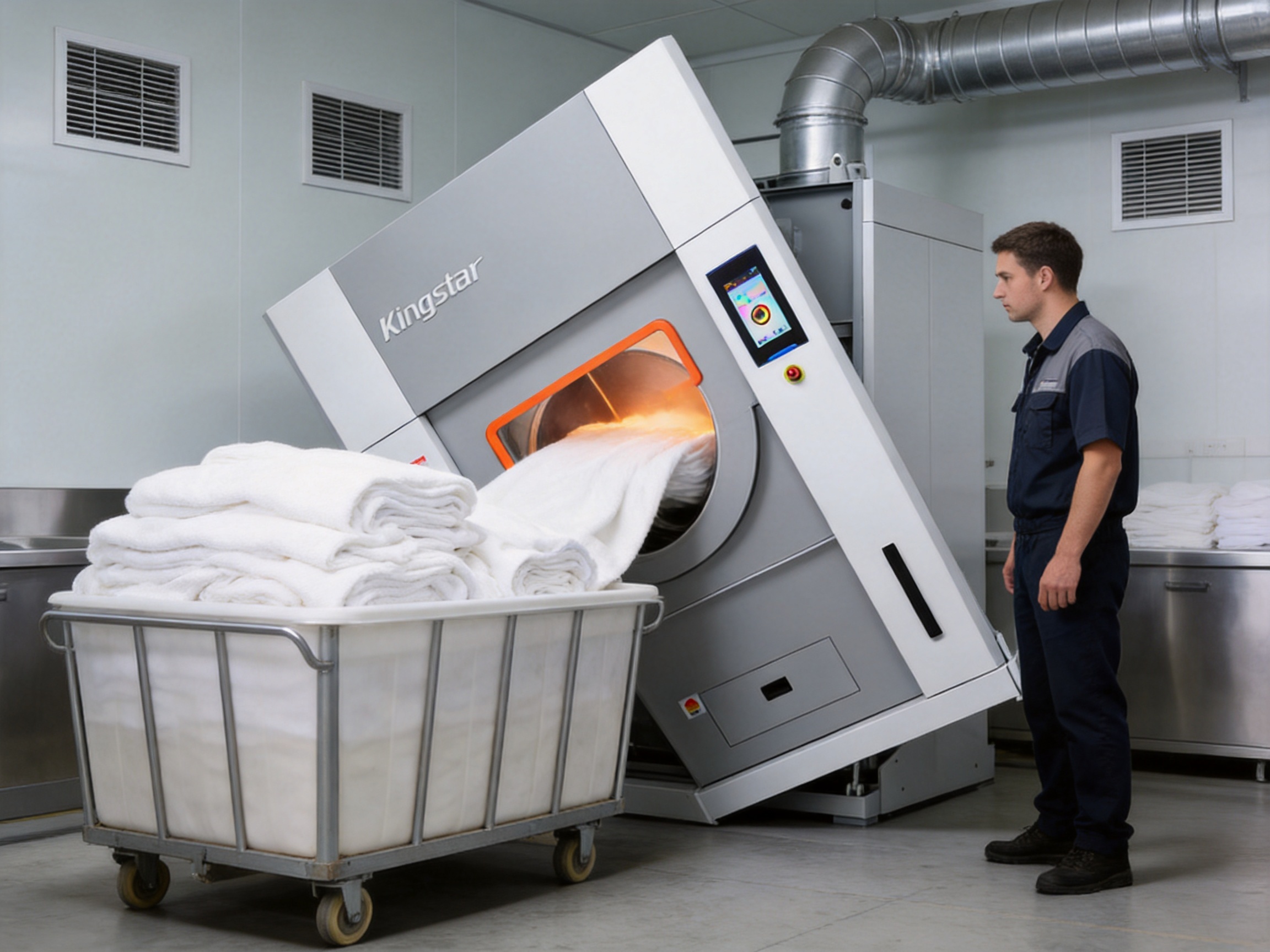
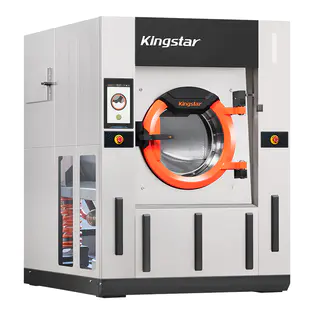
The front tilt discharge system provides a clear productivity advantage. After the drying cycle is complete, the front section can be tilted to assist with unloading. Instead of requiring operators to reach deeply into the drum, the finished textiles can be moved toward the front discharge position. This shortens the unloading process and reduces repetitive physical effort.
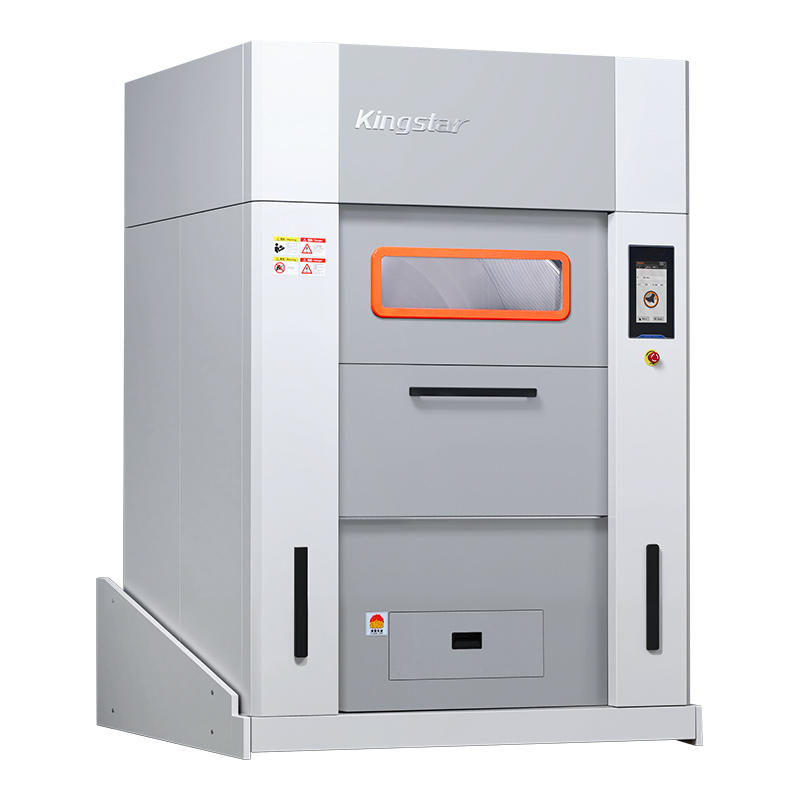
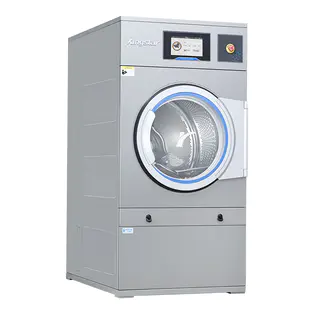
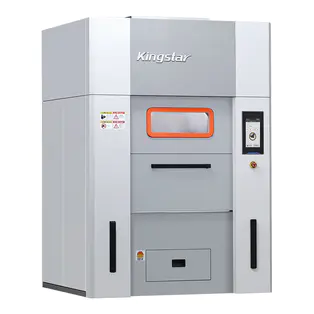
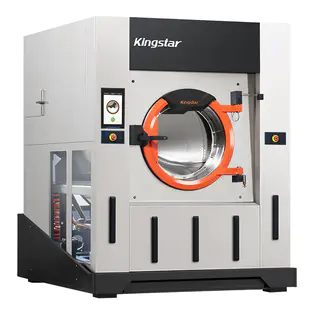
Industrial Forward Tilting Dryer
3. Intelligent Control with 99 Programmable Drying Programs
The 10.1-inch full-color HD touchscreen is the main interface between the operator and the dryer. A large industrial touchscreen is easier to read than a small basic control panel, especially in busy laundry rooms where operators may need to review settings quickly. The display supports program selection, parameter adjustment, and operational monitoring.
The control system includes up to 99 built-in editable automatic programs. This gives the laundry the ability to create drying profiles for different textiles and production requirements. For example, a facility can establish separate programs for bath towels, flat sheets, duvet covers, hospital gowns, workwear, delicate linen, and mixed loads.
Different textile categories require different drying conditions. Towels are generally more absorbent and may require a longer or warmer cycle than lightweight sheets. Hospital textiles may need carefully controlled conditions to protect fabric quality after repeated washing and drying. Uniforms may contain blended fibers that respond poorly to excessive heat. Programmable operation helps operators avoid relying on one universal cycle for every load.
Editable programs also improve standardization. When a proven cycle has been established, it can be saved and reused rather than recreated manually. This reduces variation between shifts and helps new operators follow the facility’s established procedures. Consistency is especially important in commercial laundry, where customers expect predictable quality from every batch.
The touchscreen interface can also support more efficient operator training. Clear program names and organized settings reduce the need for workers to memorize complicated combinations of time and temperature. A supervisor can define approved cycles, while operators select the appropriate program according to the textile type and load condition.
Humidity Control and Textile Protection
One of the key capabilities of the dryer is humidity control. The system is designed to monitor and regulate the drying process so that textiles are not exposed to heat longer than necessary. Once the target moisture condition is reached, the cycle can be managed more accurately than a simple fixed-time process.
Fixed-time drying can create two opposite problems. If the programmed time is too short, the load may remain damp, causing odor, storage problems, or additional processing. If the time is too long, the textiles may become excessively dry, increasing energy use and potentially contributing to fiber wear, shrinkage, or fabric damage.
Humidity control helps balance these risks. By using the moisture condition of the load as an important control factor, the machine can support more precise finishing. This is particularly valuable for absorbent textiles such as towels, which may feel dry on the outside while retaining moisture in thicker areas.
Humidity management also contributes to energy efficiency. A dryer that stops or adjusts operation when the desired moisture level is reached avoids wasting heat on an already finished load. Actual savings will depend on textile type, initial moisture content, ambient conditions, heating method, exhaust installation, and operating procedures, but the control principle supports more efficient production.
4. High Capacity and Fast Production Performance
With a nominal capacity of 100 kilograms, the Industrial Forward Tilting Dryer is intended for large-scale laundry workloads. The manufacturer states that the dryer can process a full load of towels in approximately 40 minutes under suitable operating conditions. Actual cycle time will vary according to fabric composition, residual moisture after extraction, loading density, selected heating method, ambient temperature, and target final moisture content.
The drying cycle begins before the load enters the dryer. The performance of the preceding washer-extractor has a direct effect on drying time. A well-extracted load contains less residual water and therefore requires less energy and time to dry. For this reason, the dryer should be integrated into a complete laundry workflow rather than evaluated as an isolated machine.
Large capacity reduces the number of batches required for a given daily workload. Fewer batches can simplify scheduling and reduce the time spent loading, starting, unloading, and transferring laundry. In a hotel, for example, processing more linen in each cycle can help the laundry keep pace with room turnover and housekeeping demand. In a hospital, high capacity can support the continuous movement of bedding, gowns, towels, and uniforms.
However, capacity must be used correctly. Overloading the drum can restrict textile movement and airflow, resulting in uneven drying and longer cycles. Underloading may reduce productivity and increase the energy used per kilogram. Operators should follow the recommended load ratio and classify textiles carefully to maintain balanced tumbling and consistent results.
5. Heating Options for Different Installation Conditions
The dryer supports three heating methods: steam, electric, and gas. This multi-option design is a significant advantage for international and industrial applications because laundry facilities do not all have the same utility infrastructure.
Steam Heating
Steam heating is a practical choice for facilities that already operate a central boiler system. Hotels, hospitals, textile plants, and large institutional laundries may have steam available for sterilization, pressing, washing, or other processes. Using an existing steam supply can simplify energy management and allow the laundry to coordinate several machines through one central utility system.
The specified steam pressure is 0.6 MPa, while the listed steam consumption is 240 kilograms. Installation engineers should confirm the exact consumption basis, operating pressure, condensate return arrangement, pipe sizing, safety devices, and local regulatory requirements before commissioning.
Electric Heating
Electric heating can be suitable where natural gas or steam is unavailable. It may offer a straightforward installation approach, particularly in facilities with adequate electrical capacity. The listed heater power is 81.6 kilowatts, and the machine is specified for a rated voltage of 380 volts, three-phase, 50 hertz.
Electric heating should be selected only after verifying the site’s electrical service, protection equipment, cable sizing, ventilation, and local electrical standards. The operating cost will depend on electricity prices and the facility’s load profile. In regions with abundant renewable electricity, electric heating may also support a lower-carbon laundry strategy, although the total environmental result depends on the source of the electricity.
Gas Heating
Gas heating can provide high thermal output for facilities with suitable gas infrastructure. The listed gas heating power is 86.5 kilowatts, with a stated gas consumption of 8.9 cubic meters per hour and a heat input of 295,000 BTU per hour. The gas inlet is specified as DN20.
Gas installation requires qualified engineering and compliance with local fuel-gas regulations. The facility must verify gas type, pressure, ventilation, combustion air, exhaust routing, flame safety, emergency shutoff systems, and commissioning procedures. The specification sheet lists a gas pressure range of 5–100 MPa, but this figure should be confirmed with the manufacturer and the installation engineer because the correct operating pressure depends on the gas system and burner configuration.
Specification | Details |
Model | SDR-2100T |
Rated capacity | 100 kg |
Drum volume | 2,000 L |
Drum diameter | 1,460 mm |
Drum depth | 1,200 mm |
Heating options | Steam, electric, or gas |
Main motor power | 2.2 kW |
Fan motor power | 5.5 kW |
Electric heater power | 81.6 kW |
Gas heating power | 86.5 kW |
Rated voltage | 380 V / 3 phase / 50 Hz |
Exhaust airflow | 106 m³/min |
Exhaust outlet diameter | 325 mm |
Overall dimensions | 1,750 mm W × 2,120 mm D × 2,500 mm H |
Net weight | 2,200 kg |
Touchscreen | 10.1 inches |
6. 304 Stainless Steel Drum Construction
The inner drum is manufactured from 304 stainless steel. This material is widely used in professional laundry equipment because it offers a strong balance of corrosion resistance, durability, cleanability, and suitability for repeated exposure to moisture and laundry chemicals.
Commercial laundry loads may contain detergent residues, oxygen-based chemicals, softeners, disinfecting agents, and hard-water deposits. A stainless steel working surface is easier to clean and less vulnerable to corrosion than ordinary untreated steel. It also provides a durable surface for the repeated movement of heavy towels, sheets, uniforms, and other textiles.
The inner drum perforation is specified at 8 millimeters, with a perforated sheet thickness of 1.2 millimeters. The perforation pattern supports the movement of heated air through the load while helping maintain the structural strength required for industrial operation.
Durability is not limited to the drum material. The machine also uses industrial-grade motors, bearings, electrical components, and structural assemblies. The supplied product information identifies imported components such as Mitsubishi inverters and Schneider contactors. These components are intended to support stable control, reliable switching, and long-term operation when correctly installed and maintained.
7. Insulated High-Power Heating Design
Heat must be delivered efficiently and retained inside the drying chamber. The dryer uses a high-power heating system together with an insulation layer on the outer cylinder. Insulation helps reduce heat loss from the machine surface and improves thermal stability during operation.
A well-insulated drying chamber can support faster temperature rise and help maintain a more consistent internal environment. This is important because unstable temperature conditions may result in uneven drying or unnecessary heating time. Insulation can also help make the surrounding work area more comfortable by reducing the amount of heat radiated into the laundry room.
The heater power is listed at 81.6 kilowatts for electric heating. The gas heating power is listed at 86.5 kilowatts. These are substantial outputs appropriate for a 100-kilogram industrial dryer, but the final drying performance will also depend on airflow, textile moisture content, drum loading, ambient temperature, and exhaust installation.
High-power heating should always be managed through appropriate controls rather than used continuously at maximum output. The programmable controller and humidity management system enable the machine to adjust the process according to the load. This approach supports a balance between cycle speed, textile protection, and energy use.
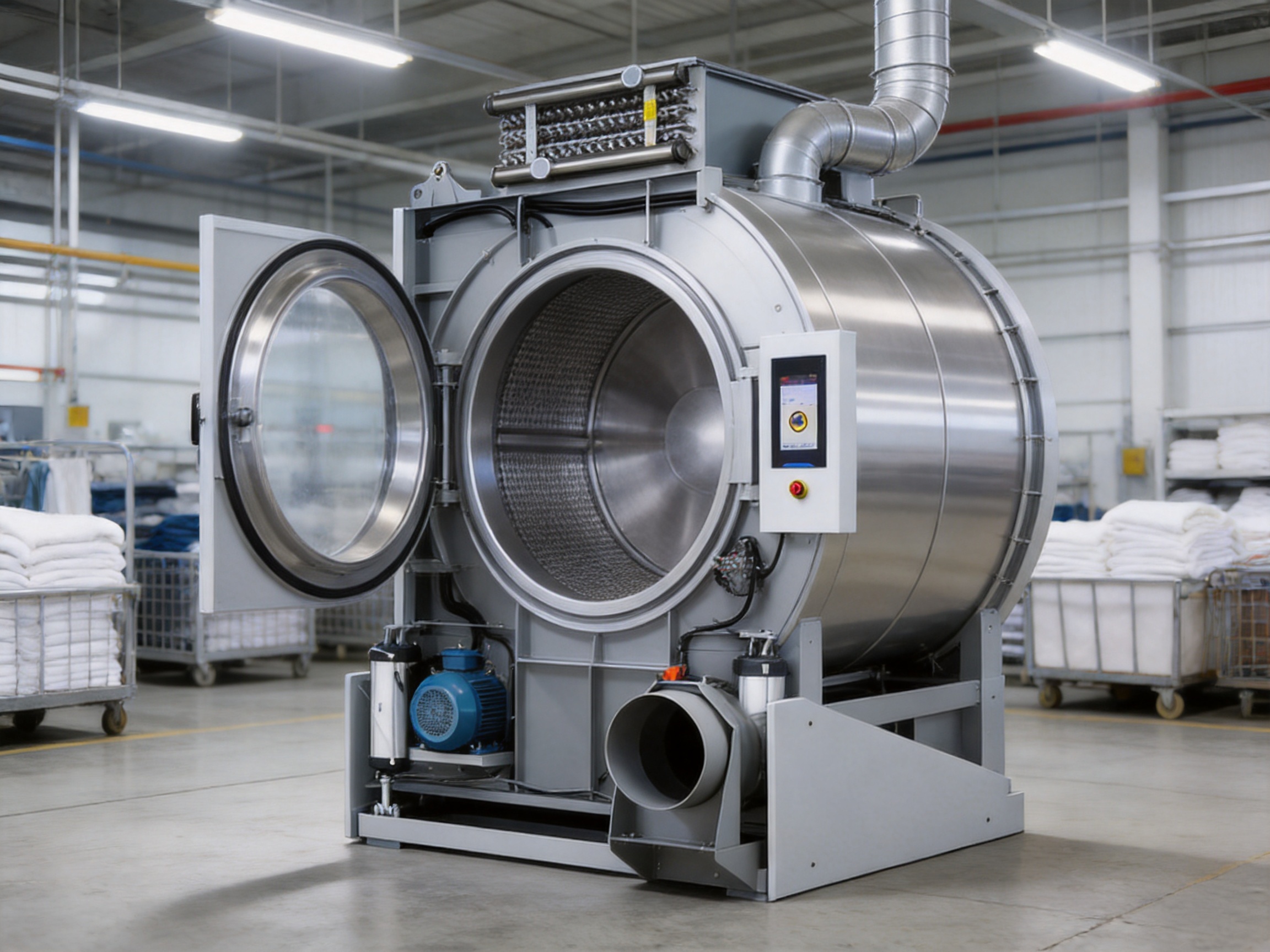
8. Forward Tilt Discharge and Ergonomic Productivity
Unloading is often overlooked when laundry equipment is compared, yet it can consume considerable labor over the course of a working day. A 100-kilogram load may contain heavy, tightly packed towels or wet-feeling textiles that are difficult to remove from a deep drum. Reaching, pulling, bending, and lifting repeatedly can create fatigue and increase the risk of workplace strain.
The forward tilt discharge system is designed to reduce these difficulties. By tilting the front of the dryer toward the unloading position, the machine helps bring finished textiles closer to the operator. This can reduce the distance that workers must reach and shorten the time required to transfer the load to carts, conveyors, or folding equipment.
The design can be especially beneficial when the dryer is integrated with a planned material-handling system. Laundry carts can be positioned at the discharge area, allowing operators to move finished textiles directly into the next stage of production. In a high-volume facility, saving a few minutes per load can produce meaningful gains across dozens of cycles.
Ergonomic improvements also have a long-term operational value. Equipment that reduces unnecessary lifting and reaching may help lower operator fatigue and support more consistent performance throughout a shift. Improved ergonomics can contribute to employee satisfaction, safer work practices, and reduced disruption caused by avoidable handling difficulties.
Large Door Design
The dryer features an upper and lower door opening design with a door diameter of approximately one meter. A large opening simplifies the loading of bulky textiles and helps operators distribute the load more evenly inside the drum.
Large doors are useful for towels, blankets, sheets, and other items that can be difficult to insert through a narrow opening. They also make inspection and routine cleaning more convenient. Operators should still follow the manufacturer’s safety procedures and ensure that the drum is stationary before opening or entering any access area.
9. Advantages Compared with Conventional Industrial Dryers
The Industrial Forward Tilting Dryer offers several advantages over basic fixed-position dryers and less sophisticated high-capacity models.
Greater Unloading Efficiency
Traditional fixed dryers may require workers to reach into the drum and manually pull out every item. The forward tilt mechanism provides assisted discharge, reducing manual handling time and improving the transition to carts or finishing equipment.
More Flexible Process Control
Basic dryers often rely on a small number of fixed time and temperature settings. The 10.1-inch touchscreen and 99 editable programs provide a more flexible platform for different fabrics, moisture levels, and customer requirements.
Better Moisture Management
Humidity control provides a more intelligent alternative to time-only operation. It helps reduce the risk of damp loads and supports the prevention of unnecessary over-drying.
Multiple Utility Configurations
Many dryers are limited to one heating source. This model supports steam, electric, and gas heating, giving facility planners greater freedom when selecting equipment for new construction, replacement projects, or international installations.
Large Commercial Capacity
A 100-kilogram rated load allows the machine to handle substantial production volumes. This can reduce batch frequency and support more efficient scheduling compared with smaller commercial dryers.
Industrial Material Selection
The 304 stainless steel inner drum, insulated cylinder, industrial motors, and imported control components are selected for demanding laundry environments. These features are intended to support durability and stable performance under repeated use.
Reduced Risk of Heat Loss
The added insulation layer helps retain heat within the drying chamber. This supports faster heating and may improve energy utilization compared with poorly insulated equipment, although actual consumption depends on the complete installation and operating method.
10. Manufacturing Strengths and Engineering Approach
The manufacturer, Jiangsu Chuandao Intelligent Equipment Co., Ltd., operates in Nantong, Jiangsu Province, China, and supplies laundry machinery for industrial and commercial applications. Its product range includes industrial washing machines, hospital washing machines, industrial dryers, commercial washer-extractors, stacked washer and dryer systems, stack dryers, and commercial dryers.
This product range indicates experience across several connected stages of the laundry process. A company that develops both washing and drying equipment can better understand the relationship between extraction performance, drying capacity, heat input, airflow, textile handling, and finishing requirements. Such system knowledge is important when customers require more than a single standalone machine.
The dryer’s design reflects an engineering focus on practical industrial use. Its large capacity is matched with a correspondingly large drum, high airflow, high-power heating options, robust access doors, programmable control, and mechanical discharge assistance. These features must work together; capacity alone is not enough to produce a productive machine.
The use of imported electrical components is another stated manufacturing strength. Mitsubishi inverters can support motor speed control, while Schneider contactors are commonly used for industrial switching applications. The manufacturer also identifies imported wires, plugs, and bearings as part of the equipment configuration. Component selection should always be verified against the final bill of materials for the specific order, but the stated approach demonstrates attention to electrical reliability and service life.
Manufacturing quality also depends on assembly accuracy and process control. Large industrial dryers require careful alignment of the drum, drive system, fan, heating section, door assemblies, tilt mechanism, and supporting frame. Correct alignment helps limit vibration, reduce bearing stress, and maintain reliable operation. Welding quality, surface treatment, insulation installation, electrical wiring, and final testing are equally important.
For export customers, manufacturing strength also includes the ability to adapt equipment to different power standards, heating sources, safety requirements, shipping conditions, and installation environments. The availability of steam, electric, and gas configurations provides a foundation for such adaptation. Customers should confirm optional features, control language, voltage, frequency, burner specifications, certifications, packaging, and documentation before placing an order.
11. Installation Planning and Site Requirements
The dryer has overall dimensions of approximately 1,750 millimeters in width, 2,120 millimeters in depth, and 2,500 millimeters in height. Its net weight is approximately 2,200 kilograms. These dimensions and weight must be considered during building design, equipment delivery, positioning, and foundation preparation.
The installation area should provide enough clearance for loading, unloading, maintenance, door movement, tilt travel, exhaust ducting, heating connections, and electrical service. The ceiling height must accommodate the 2,500-millimeter machine height as well as any required lifting or service clearance.
The floor should be suitable for the static and dynamic loads generated by the dryer. Industrial laundry equipment may create vibration during rotation, particularly if loads are unevenly distributed. A level and properly prepared foundation supports stable operation and helps protect the drive system.
Exhaust design is critical. The exhaust outlet diameter is specified as 325 millimeters, with an airflow of 106 cubic meters per minute. Ducting should be designed to minimize unnecessary bends, restrictions, and back pressure. The discharge location must comply with local building, fire, and ventilation requirements.
Steam, gas, and electric installations must be completed by qualified professionals. Gas systems require suitable ventilation and combustion safety. Steam systems require proper valves, pressure control, condensate management, and thermal protection. Electric systems require correctly rated disconnects, protection devices, grounding, and wiring.
Before installation, the purchaser should confirm the following items:
1. Available floor area and maintenance clearance.
2. Floor loading and foundation requirements.
3. Exhaust duct route and external discharge location.
4. Electrical voltage, phase, frequency, and installed capacity.
5. Steam pressure and condensate return arrangements, where applicable.
6. Gas type, pressure, ventilation, and safety requirements, where applicable.
7. Compressed-air availability, including the specified 8-millimeter inlet connection.
8. Door and building access dimensions for delivery.
9. Load transfer arrangements, including laundry carts or conveyors.
10. Local workplace safety and fire protection compliance.
12. Maintenance and Operating Recommendations
Regular maintenance is essential for reliable dryer performance. Operators should clean lint and textile residue from filters, ducts, accessible air passages, and surrounding areas according to the manufacturer’s maintenance schedule. Lint accumulation can restrict airflow and create a fire hazard, particularly in high-volume operations.
The exhaust system should be inspected routinely. A restricted duct can reduce airflow, extend drying time, increase energy consumption, and place additional demand on the fan and heating system. The fan motor, drive components, bearings, seals, door mechanisms, and tilt system should also be checked at defined intervals.
Operators should monitor unusual noise, vibration, temperature, odor, or changes in drying time. These may indicate airflow restrictions, uneven loading, worn bearings, drive problems, control faults, or heating-system issues. Early inspection can prevent a minor problem from becoming an extended production stoppage.
The 304 stainless steel drum should be kept clean and free from objects that could damage the perforated surface. Zippers, metal fasteners, and foreign objects should be checked before loading. Although the drum is designed for industrial use, correct textile preparation remains important for protecting both the machine and the laundry.
Loads should be classified by fabric type, weight, color, and drying requirement. Mixing very heavy towels with lightweight garments can lead to uneven drying. Overloading reduces tumbling space, while underloading may reduce productivity. Operators should select a suitable program and avoid using excessive heat simply to shorten a cycle.
Safety procedures should include verifying that doors are closed before operation, keeping personnel clear of moving and tilting mechanisms, isolating power before maintenance, and preventing unauthorized access to service areas. Heating systems and exhaust ducts may remain hot after a cycle, so appropriate precautions are necessary.
13. Applications Across Multiple Industries
Hotels and Resorts
Hotels process towels, sheets, pillowcases, bath mats, robes, and other linen on a daily basis. The 100-kilogram capacity can support high room counts and peak occupancy periods. The programmable controller allows housekeeping textiles to be assigned dedicated cycles, while the front tilt discharge can accelerate the movement of finished linen to folding or storage areas.
Hospitals and Healthcare Facilities
Hospitals require dependable laundry processing for bedding, patient garments, staff uniforms, towels, and protective textiles. Different materials may need different drying conditions, making programmable operation valuable. The stainless steel drum and cleanable construction also support the hygienic expectations of institutional laundry environments. The dryer should be integrated into the hospital’s approved textile-handling and infection-control procedures.
Self-Service and Commercial Laundries
Large commercial laundries need equipment that can process customer orders quickly and consistently. The dryer’s high capacity, touchscreen control, humidity management, and multiple heating options can help support a professional production workflow.
Uniform Rental and Workwear Services
Uniform rental companies process workwear in large batches and often manage textiles made from cotton, polyester blends, and specialty fabrics. Program customization allows cycles to be adapted to fabric composition and customer requirements. Consistent drying can improve the quality of garments before pressing, folding, packing, and delivery.
Industrial and Manufacturing Facilities
Factories, workshops, food-processing plants, and other industrial organizations may operate their own laundry departments for uniforms, cleaning cloths, protective garments, and reusable textiles. A large dryer can help these facilities reduce dependence on external services while supporting a more controlled internal process.
14. Total Cost of Ownership Considerations
The purchase price is only one part of the cost of owning an industrial dryer. Buyers should also consider energy consumption, labor, maintenance, spare parts, downtime, installation, ventilation, and expected service life.
The forward tilt system may reduce labor time during unloading. The programmable controller can improve consistency and reduce operator errors. Humidity control may reduce over-drying and unnecessary energy use. The insulated cylinder can help limit heat loss. These benefits may contribute to a lower total cost of ownership over the equipment’s operating life.
Utility selection is another major cost factor. Steam, electricity, and gas have different local prices and infrastructure requirements. A buyer should compare the full installation and operating cost of each option rather than choosing solely according to the rated heater power.
Maintenance planning is equally important. A robust machine can still experience avoidable downtime if filters are neglected, ducts are restricted, bearings are not lubricated when required, or warning signs are ignored. A documented preventive maintenance program supports more predictable operating costs.
Productivity should be evaluated in kilograms processed per shift, not only in kilograms per cycle. A dryer that unloads quickly and requires less operator intervention may produce more useful output than a similar-capacity machine with slower handling. The machine’s program flexibility also helps facilities optimize cycles for their own textile mix instead of relying on unnecessarily long standard settings.
15. How to Select the Right Configuration
Before ordering, the purchaser should identify the dominant textile categories, average load weight, expected daily throughput, residual moisture after extraction, available energy sources, and desired cycle times. These factors determine whether steam, electric, or gas heating is most appropriate.
Facilities should also evaluate whether the dryer will operate alongside washer-extractors, flatwork ironers, folding machines, carts, conveyors, or automated handling equipment. The discharge direction and machine layout should be considered during the design phase so that the forward tilt function delivers its full productivity benefit.
Control requirements should be discussed in detail. Customers may need specific program names, language settings, temperature units, user permissions, data records, alarms, or integration with a central laundry management system. These requirements should be confirmed before production.
Purchasers should request final technical drawings, utility requirements, installation instructions, spare-parts information, warranty terms, operator manuals, and commissioning procedures. They should also verify the exact specifications for gas pressure, steam consumption, compressed-air requirements, safety interlocks, and electrical protection.
16. Questions and Answers
Q1: What is the rated capacity of the Industrial Forward Tilting Dryer?
The rated capacity is 100 kilograms. Actual recommended loading may vary according to textile type, moisture content, and the operating program.
Q2: What heating methods are available?
The dryer supports steam, electric, and gas heating. The appropriate choice depends on local utilities, installation conditions, energy pricing, and facility requirements.
Q3: How does the forward tilt function improve productivity?
The front tilt discharge moves the finished load toward the unloading position, reducing the need for operators to reach deeply into the drum. This can shorten unloading time and reduce physical strain.
Q4: Does the dryer support different fabric types?
Yes. The touchscreen controller provides up to 99 editable automatic programs. Operators can configure different cycles for towels, sheets, uniforms, hospital textiles, and other materials.
Q5: What is the purpose of humidity control?
Humidity control helps manage the drying process according to the moisture condition of the textiles. It is designed to reduce under-drying and unnecessary over-drying, which can save energy and help protect fabric quality.
Q6: What material is used for the inner drum?
The inner drum is made of 304 stainless steel. This material provides corrosion resistance, durability, and a cleanable working surface for commercial laundry use.
Q7: What is the expected drying time?
The supplied product information states that a 100-kilogram towel load can be dried in approximately 40 minutes under suitable conditions. Actual time depends on extraction results, textile type, load size, heating method, airflow, and target moisture level.
Q8: What electrical supply is specified?
The listed rated voltage is 380 volts, three-phase, 50 hertz. The final electrical requirements should be confirmed for the selected configuration and local installation standards.
Q9: What exhaust airflow is required?
The specified exhaust airflow is 106 cubic meters per minute, with an exhaust outlet diameter of 325 millimeters. Duct design and site conditions should be verified by qualified installation personnel.
Q10: Is the machine suitable for hospitals?
It is designed for high-efficiency use in hotel, hospital, and self-service laundry environments. Hospital operators should integrate it into their own approved laundry, hygiene, textile segregation, and safety procedures.
Q11: How many drying programs are available?
The control system provides 99 built-in editable automatic programs. These can be assigned to different textile categories and operating requirements.
Q12: What should be checked before installation?
Buyers should verify floor loading, access dimensions, electrical service, heating source, exhaust routing, ventilation, compressed air, maintenance clearance, safety requirements, and local regulations.
17. Conclusion
The Industrial Forward Tilting Dryer is designed to address the practical requirements of high-volume laundry operations. Its 100-kilogram capacity, 2,000-liter drum, high airflow, powerful heating options, and robust stainless steel construction provide a strong foundation for commercial and institutional drying.
Its greatest distinction is the way multiple productivity features are combined in one machine. The 10.1-inch touchscreen and 99 editable programs support process flexibility. Humidity control helps manage final moisture and avoid unnecessary drying. Steam, electric, and gas heating configurations improve installation adaptability. The insulated cylinder supports thermal efficiency, while the large door and forward tilt discharge simplify loading and unloading.
Compared with a basic fixed-position dryer, this model offers greater control, more flexible utilities, and improved handling ergonomics. These advantages can help hotels, hospitals, commercial laundries, uniform services, and industrial facilities improve throughput while maintaining consistent textile quality.
The manufacturer’s focus on industrial laundry equipment, stainless steel construction, imported electrical components, and configurable heating systems further supports the machine’s positioning as a professional production solution. Correct installation, suitable textile classification, regular cleaning, preventive maintenance, and trained operation remain essential for achieving the best results.
For facilities seeking to modernize their drying process, reduce manual unloading effort, and manage large volumes with greater consistency, the Industrial Forward Tilting Dryer offers a comprehensive combination of capacity, intelligent control, heating flexibility, and industrial handling performance.
References
1. Product specification sheet for Industrial Forward Tilting Dryer, model SDR-2100T.
2. Manufacturer-provided technical information on drum construction, heating systems, control functions, and discharge design.
3. General industrial laundry equipment maintenance and operational practice guidelines.
4. Commercial textile drying principles covering airflow, residual moisture, heat transfer, and fabric protection.
5. General workplace safety principles for rotating machinery, industrial heating equipment, exhaust systems, and laundry handling operations.
Product: Industrial Forward Tilting Dryer

ADD:No.388 Xinggang Road, Chongchuan District, Nantong City, 226000, Jiangsu Province, China.
-
Phone: +86-13917089379
-
Tel:+86-13917089379
-
Fax:+86-0513-85663366
-
E-mail:louislu@kingstarlaundry.com
products