英语
英语 俄语
俄语 西班牙语
西班牙语 德语
德语
Home / Author / Yutong Cai — Customer Solutions Specialist / 100kg Single Tumble Dryer: High-Capacity, Energy-Efficient Drying for Professional Laundry Operations

Kingstar is your trusted partner for industrial and commercial laundry equipment. We specialized in the R&D and manufacturing of high-end industrial washers, commercial washers and dryers. Meanwhile, we provide global clients with comprehensive planning, layout workflow design, and software-hardware integration services for smart laundry plants.
Yutong Cai — Customer Solutions Specialist
Oct 02,2026
100kg Single Tumble Dryer: High-Capacity, Energy-Efficient Drying for Professional Laundry Operations
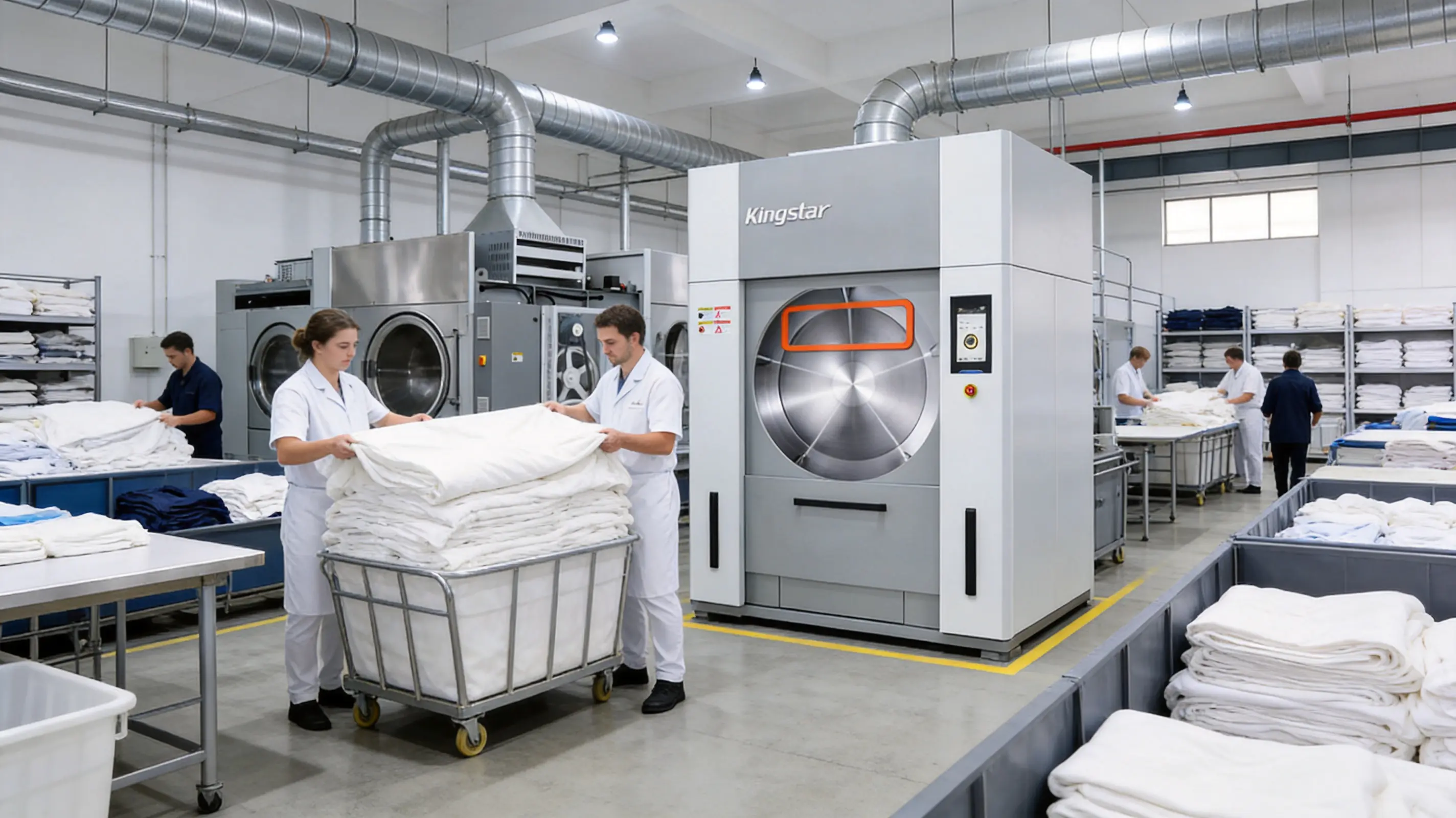
In commercial and industrial laundry environments, drying capacity, operating consistency, fabric protection, and energy efficiency directly influence productivity and operating costs. A high-capacity dryer must do more than remove moisture. It must process substantial volumes of textiles within predictable timeframes, protect different fabric types, provide simple controls for operators, and remain dependable through repeated daily use.
The 100kg Single Tumble Dryer is engineered for demanding laundry applications that require efficient, stable, and flexible drying performance. With a nominal capacity of 100 kilograms, a 2,000-liter drum volume, intelligent humidity verification, programmable drying time control, and steam heating, the machine is suitable for hotels, hospitals, commercial laundries, dry cleaners, self-service laundry facilities, and other professional textile-care operations.
Unlike basic dryers that operate according to fixed time settings, this machine is designed to respond more intelligently to the actual condition of the load. Its humidity verification technology helps monitor moisture during the drying process, while intelligent time control can reduce unnecessary drying. These functions support consistent results, reduce the risk of over-drying, and help control energy consumption.
The machine is also designed around practical industrial requirements. A large-diameter drum, robust drive system, high airflow capacity, steam heating, programmable operation, and humanized controls work together to create a reliable drying solution for large batches of towels, sheets, uniforms, garments, hospital textiles, and other washable materials.
1. The Role of High-Capacity Drying in Modern Laundry Operations
Drying is often one of the most time-consuming stages in a professional laundry workflow. Washing equipment can process a large quantity of textiles in a short time, but if drying capacity is insufficient, clean laundry can accumulate between washing and finishing. This creates delays, increases labor pressure, and may affect delivery schedules.
A 100kg dryer addresses this bottleneck by allowing a large load to be processed in one cycle. Instead of dividing the same batch among several smaller machines, operators can reduce the number of loading and unloading operations. This helps simplify workflow, especially in facilities handling large quantities of bed linen, towels, uniforms, tablecloths, workwear, or healthcare textiles.
High capacity is particularly valuable when laundry demand changes throughout the day. Hotels may experience heavy demand after guest check-out. Hospitals must process bedding, gowns, scrubs, and other textiles continuously. Commercial laundries may serve several customers with different collection and delivery times. A large dryer provides additional processing capacity and helps operators respond to these changing requirements.
However, capacity alone does not determine performance. An industrial dryer must distribute heat and airflow evenly through the load. It must also tumble textiles effectively without creating excessive fabric stress. The 100kg Single Tumble Dryer combines a large drum with a dedicated air motor and a stable drive motor to support balanced and efficient drying.
Its drum diameter is 1,460 millimeters, and its drum depth is 1,200 millimeters. These dimensions provide substantial internal space for textile movement. Effective tumbling helps separate items, expose more surface area to heated air, and promote consistent moisture removal from the center and outer layers of the load.
2. Main Technical Specifications
| Item | Specification |
|---|---|
| Model | SDR-2100 |
| Nominal capacity | 100kg |
| Drum diameter | 1,460mm |
| Drum depth | 1,200mm |
| Drum volume | 2,000 liters |
| Volume load ratio | 20 |
| Main motor power | 2.2kW |
| Air motor power | 5.5kW |
| Heating method | Steam heating |
| Rated voltage | 380V |
| Steam pressure | 0.6MPa |
| Machine width | 1,638mm |
| Machine depth | 2,100mm |
| Machine height | 2,630mm |
| Approximate machine weight | 2,300kg |
The specifications indicate that the dryer is intended for professional facilities with suitable floor space, electrical service, steam supply, ventilation, and material-handling arrangements. Before installation, the buyer should confirm site conditions, access dimensions, foundation requirements, exhaust arrangements, and local safety requirements.
3. Large Drum Capacity for More Efficient Production
The primary advantage of a 100kg single dryer is its ability to handle substantial loads in one machine. In high-volume laundries, reducing the number of cycles can improve productivity and simplify scheduling. Operators can load, program, and unload larger batches instead of repeatedly managing several small machines.
The 2,000-liter drum volume creates room for textiles to move through the drying chamber. Proper movement is essential because a tightly compressed load can slow moisture transfer and create uneven drying. When textiles tumble freely, heated air can reach more surfaces and carry moisture away more effectively.
The large drum is suitable for a wide range of textile categories, including:
Hotel sheets, pillowcases, duvet covers, towels, bath mats, robes, table linens, restaurant textiles, uniforms, industrial workwear, hospital bedding, patient garments, scrubs, gowns, and other washable materials.
Different textiles may require different drying conditions. Towels and heavy cotton articles typically require substantial airflow and drying energy. Sheets and lightweight fabrics may dry more quickly. Workwear can contain thicker seams and pockets that retain moisture. The machine’s programmable controls allow operators to adjust drying conditions according to the material, load size, and required finish.
Large capacity also contributes to better labor utilization. When the machine processes more textiles per cycle, personnel spend less time transferring laundry between small machines. This can free staff to focus on sorting, folding, finishing, quality checks, packing, and delivery preparation.
Compared with multiple small dryers, a single high-capacity dryer can also make floor planning more straightforward. The final decision depends on the facility’s production pattern, but a large machine may reduce the number of separate loading zones, control panels, and maintenance points required for a comparable total capacity.
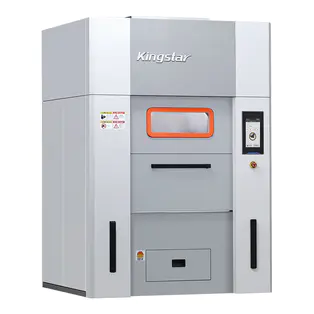
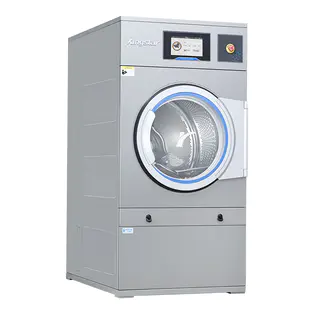
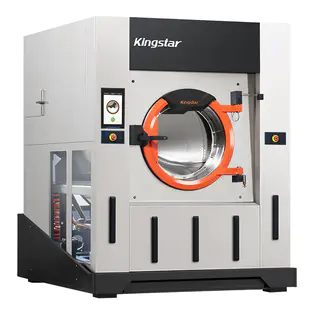
100kg Single Tumble Dryer
4. Intelligent Humidity Verification and Moisture Control
One of the most important features of the 100kg Single Tumble Dryer is its intelligent humidity verification technology. Drying should not be controlled only by elapsed time because the moisture content of a load changes according to fabric type, initial extraction, load weight, ambient conditions, and textile thickness.
A fixed timer may stop too early, leaving damp areas in heavy items. It may also run too long, causing unnecessary energy use and exposing textiles to excess heat. Humidity verification helps the dryer respond more accurately to the condition of the load.
During operation, the system is designed to monitor moisture conditions and support more precise drying decisions. When the load reaches the intended dryness level, the operator can avoid extending the cycle unnecessarily. This is particularly valuable for facilities that process a mixture of heavy and lightweight textiles.
Moisture control provides several practical benefits:
First, it supports more consistent results. Laundry that leaves the dryer with an appropriate moisture level is easier to fold, iron, finish, store, or deliver.
Second, it helps reduce over-drying. Excessive heat and prolonged tumbling can place additional stress on fibers, colors, seams, elastic components, and surface finishes. Controlling the end point can help preserve textile quality over repeated processing.
Third, it can support energy management. Every unnecessary minute of heating and airflow adds to operating consumption. By reducing avoidable drying time, humidity-based control can contribute to lower energy use per kilogram of processed laundry.
Fourth, it helps operators establish repeatable programs. Once suitable settings are developed for towels, sheets, uniforms, or healthcare textiles, staff can use consistent procedures rather than relying solely on personal judgment.
Moisture verification does not eliminate the need for correct loading, extraction, sorting, and program selection. It works most effectively when used as part of a complete laundry process. Proper washing, effective hydro-extraction, suitable load size, clean filters, and correct ventilation all influence drying performance.
5. Intelligent Drying Time Control
The dryer also includes intelligent drying time control. This function complements humidity verification by helping operators manage cycle duration more effectively. A drying program can be configured according to the load and then adjusted based on actual drying progress.
Traditional manual operation often encourages staff to add extra time as a precaution. Although this approach may seem safe, it can lead to over-drying and higher operating costs. Intelligent time control provides a more disciplined approach by helping the machine stop or transition when the selected drying objective has been achieved.
For hotels, this means linens can be returned to service more quickly. For hospitals, it helps maintain a predictable supply of clean textiles. For commercial laundries, it supports production planning and delivery commitments. For self-service facilities, it provides customers with a more understandable and repeatable drying experience.
Drying time depends on several variables, including the residual moisture after washing, the composition of the textile, the weight of the load, the steam condition, and the ventilation system. Therefore, users should establish operating programs through practical testing. A well-adjusted program can provide a balance between drying speed, fabric care, energy use, and final moisture content.
Operators should also recognize that a dryer’s controls are only one part of energy management. The washing and extraction stages strongly influence dryer performance. Efficient hydro-extraction removes more water before drying begins, which can shorten drying time. Correct sorting prevents lightweight items from being over-processed because they are mixed with heavy articles.
6. Steam Heating for Professional Laundry Facilities
The 100kg Single Tumble Dryer uses steam heating. Steam is widely used in industrial and commercial laundries because many large facilities already operate a central boiler or steam-generation system. A central steam system can supply heat to several pieces of laundry equipment, allowing the facility to coordinate its energy infrastructure.
The specified steam pressure is 0.6MPa. The actual installation must be designed and commissioned according to local regulations, plant conditions, pressure-control requirements, condensate management, and the equipment’s approved operating parameters.
Steam heating can offer several advantages in a professional environment. It allows heat to be transferred efficiently through a dedicated heating system. It can also support continuous production when the facility has a stable steam supply. In addition, central steam management may be convenient for laundries that use steam in washers, presses, finishing machines, or other equipment.
A steam-heated dryer requires appropriate supporting systems. These may include steam valves, pressure regulation, filters, traps, condensate drainage, safety devices, and properly designed exhaust ducting. Regular inspection of these components is important for maintaining heating performance and protecting the equipment.
Because steam quality affects heat transfer, facility managers should maintain the steam system according to professional engineering practice. Poor condensate removal, unstable pressure, blocked filters, or inadequate ventilation can reduce drying efficiency even when the dryer itself is operating correctly.
7. Airflow and Motor Configuration
Airflow is central to drying performance. Heat alone cannot remove moisture efficiently unless humid air is carried away from the drum and replaced with suitable heated air. The machine is equipped with a 5.5kW air motor to support the airflow system, while a 2.2kW main motor drives the drum movement.
The separation of drum drive and air movement functions allows each system to perform its specific task. The main motor supports controlled tumbling, while the air motor supports the circulation and exhaust requirements of the drying process. Together, these systems help maintain the movement of textiles and heated air inside the machine.
Strong airflow is especially important when processing thick towels, heavy bedding, workwear, or other materials that retain water. It also helps remove humid air from the drum, allowing the drying process to continue rather than reaching a point where moisture becomes trapped around the load.
Airflow performance depends on the entire exhaust installation. Duct length, bends, outlet design, filters, building ventilation, and external resistance can all affect results. The dryer should therefore be installed with an exhaust system designed by qualified personnel. Filters and air passages should be checked regularly to prevent lint accumulation and maintain stable airflow.
A clean and efficient airflow path can support shorter cycles, more uniform results, and improved operating stability. It also contributes to safer operation by helping manage heat and lint within the system.
8. Construction for Repeated Commercial Use
A professional dryer must withstand frequent loading, unloading, starting, stopping, and cleaning. It may operate for many cycles every day, often under demanding production schedules. The machine’s approximate weight of 2,300 kilograms reflects its large industrial scale and substantial construction.
Heavy-duty equipment requires a suitable installation base. The floor should be capable of supporting the machine, its dynamic movement, and the maximum operating load. Access routes should also be evaluated before delivery, since the machine’s dimensions are approximately 1,638 millimeters wide, 2,100 millimeters deep, and 2,630 millimeters high.
Durability is not limited to the outer structure. Reliable performance depends on the coordinated quality of the drum, bearings, drive assembly, heating components, airflow system, control system, doors, seals, wiring, and safety devices. A weakness in any one of these areas can affect the entire production process.
The design emphasis on simple operation and humanized use is important because industrial equipment is often operated by several shifts of staff with different levels of experience. Controls should be understandable, routine procedures should be clear, and access for inspection and cleaning should be considered during installation planning.
Regular maintenance should include inspection of drive components, cleaning of lint filters, checking of airflow passages, examination of seals and doors, verification of steam connections, and review of electrical and control-system conditions. Preventive maintenance is generally more effective than waiting for a failure to interrupt production.
9. Advantages Compared with Basic Tumble Dryers
Compared with a basic time-controlled dryer, the 100kg Single Tumble Dryer offers a more complete approach to professional drying. Its advantages are associated with capacity, monitoring, control, airflow, heating compatibility, and production flexibility.
Higher Processing Capacity
A 100kg load rating allows the machine to process large batches. This can reduce the number of cycles needed for a daily production schedule and help facilities handle peak demand.
More Accurate Drying Decisions
Humidity verification provides information about the actual condition of the load rather than relying only on a preset timer. This supports better control over the drying endpoint.
Reduced Risk of Over-Drying
Intelligent drying time control helps limit unnecessary operation after textiles have reached the required condition. This can support fabric care and reduce wasted energy.
Steam System Compatibility
Steam heating is suitable for facilities that already use central steam infrastructure. It can be integrated into a broader industrial laundry heating system when correctly installed.
Improved Workflow
Large-batch drying can reduce repeated handling and help create a more efficient transition from washing to finishing, folding, storage, and dispatch.
Flexible Application
Programmable operation allows the machine to accommodate different loads, including thick towels, light sheets, workwear, hospital textiles, and other commercial laundry products.
Industrial-Scale Engineering
The substantial drum, motor configuration, and machine weight are suited to commercial environments rather than occasional domestic use. This makes the dryer a practical choice for users who require regular production performance.
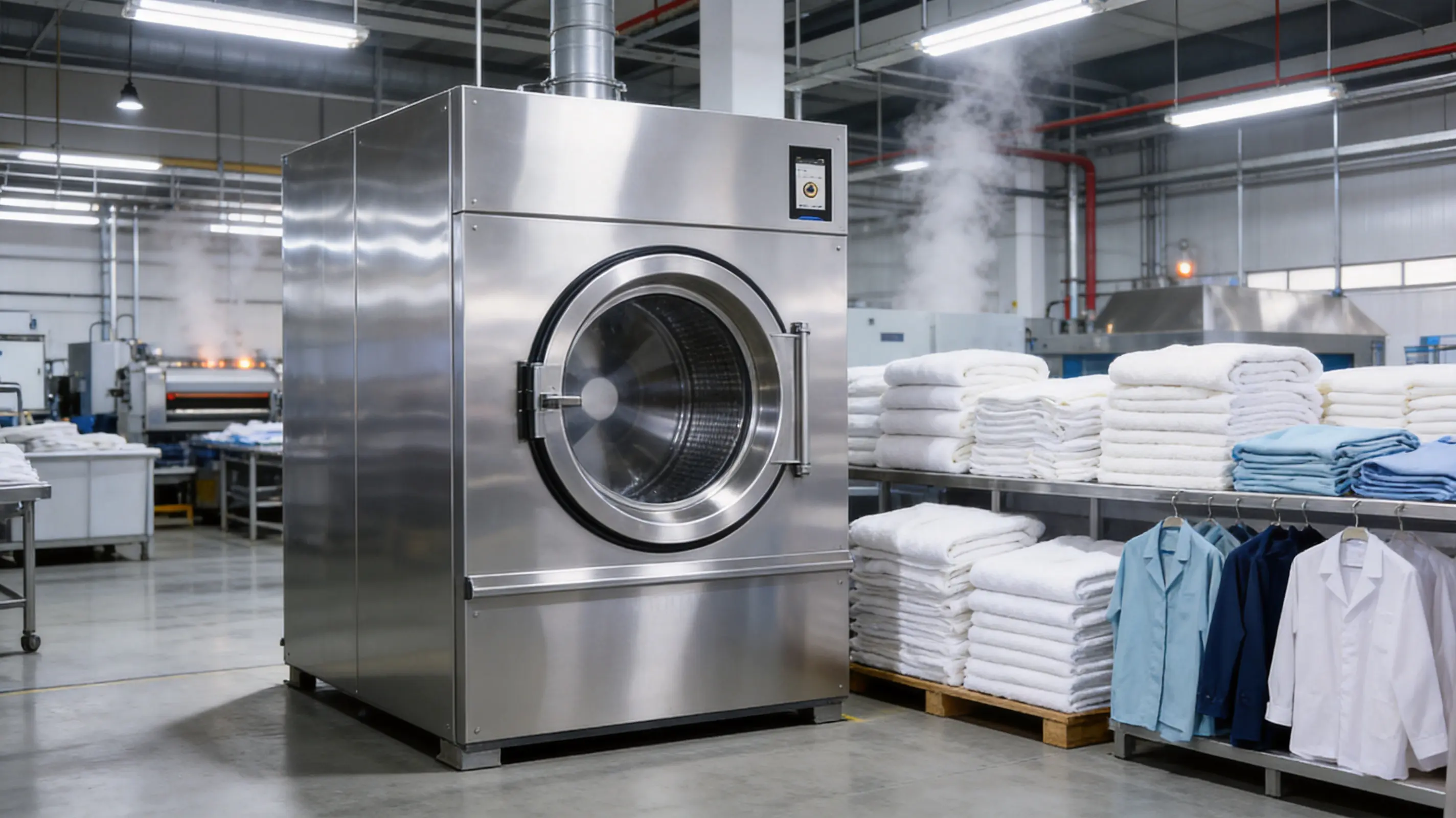
10. Applications Across Different Industries
Hotels and Resorts
Hotels need a steady supply of clean, dry, and presentable textiles. Sheets, pillowcases, towels, robes, restaurant linens, and staff uniforms may all pass through the laundry department. Delays in drying can affect room turnover and guest service.
The 100kg capacity is suitable for facilities that handle substantial quantities of hotel linen. Operators can create separate programs for towels, sheets, uniforms, and delicate articles. Moisture verification can help prevent excessive drying, which is useful for preserving the appearance and hand feel of frequently processed textiles.
Hospitals and Healthcare Facilities
Hospitals process bedding, gowns, scrubs, patient garments, curtains, and other textile products. The laundry workflow must be organized, repeatable, and dependable. Drying performance is important because textiles may need to return to service quickly.
The machine’s programmable controls can support standardized procedures for different categories of healthcare textiles. Facilities should define their own validated washing, drying, hygiene, and handling protocols in accordance with applicable healthcare requirements.
Commercial Laundry Services
Commercial laundries serve customers with different textile types, weights, and turnaround expectations. A high-capacity dryer can help consolidate production and provide the flexibility needed to process larger customer orders.
Because commercial laundries often calculate costs by load, kilogram, or customer contract, energy control and cycle consistency are especially important. Humidity verification and intelligent time control can support more predictable processing and reduce avoidable drying time.
Dry Cleaners and Textile-Service Businesses
Some dry cleaners and textile-service businesses also process washable uniforms, towels, bedding, workwear, or household textiles. A dedicated high-capacity dryer can expand service capability and reduce dependence on smaller machines.
Operators should always select suitable drying programs for each textile category. Items with special coatings, adhesives, elastic components, or heat sensitivity should be processed according to the manufacturer’s care instructions.
Self-Service Laundry Facilities
Self-service laundry facilities often need machines that are easy to understand and capable of handling large family or commercial loads. A large dryer can serve customers with bedding, blankets, towels, and other bulky items that are difficult to dry in small domestic machines.
In this environment, clear instructions, safe access, routine cleaning, and straightforward program selection are essential. Facility operators should determine whether the machine’s capacity and installation requirements match the customer profile and available site space.
Industrial and Institutional Laundries
Factories, educational institutions, public-service organizations, and other large facilities may operate their own laundry departments. These users often value production stability, simple operation, and manageable maintenance requirements.
The 100kg dryer can be incorporated into a complete laundry line that includes sorting tables, washer-extractors, hydro-extraction, drying, ironing, folding, and storage. Its performance should be evaluated as part of the entire process rather than as an isolated machine.
11. Manufacturing Strength and Engineering Approach
The manufacturer, Jiangsu Chuandao Intelligent Equipment Co., Ltd., specializes in washing machinery and laundry equipment for commercial and industrial users. Its product range includes industrial washing machines, hospital washing machines, industrial dryers, commercial washer-extractors, stacked washer and dryer systems, stack dryers, and commercial dryers.
This product focus provides an important engineering advantage. A company that develops multiple types of laundry equipment can understand how washing, extraction, drying, and finishing stages interact. That experience supports more practical equipment design and helps customers plan complete laundry systems rather than purchasing unrelated individual machines.
The company also provides OEM and ODM-oriented services. This is valuable for distributors, laundry-equipment integrators, hospitality groups, and institutional buyers that may require specific electrical standards, control preferences, exterior configurations, documentation, or production arrangements.
Manufacturing strength in industrial laundry equipment depends on more than assembly. It includes material selection, structural engineering, component integration, electrical design, control programming, production inspection, testing, packaging, and after-sales coordination. Each stage influences the machine’s service life and operating reliability.
Engineering of the Drum and Drive System
The drum must withstand repeated rotation, textile impact, heat exposure, and varying load conditions. Its geometry influences tumbling action, airflow contact, loading efficiency, and unloading behavior. The drive system must provide stable rotation while operating within the machine’s intended load range.
A properly engineered drum and drive assembly helps prevent unnecessary vibration, supports even textile movement, and improves operator confidence during repeated cycles. Production inspection should focus on alignment, rotation, fastening, balance, and the condition of relevant mechanical components.
Integration of Heating and Airflow
Heating and airflow must be designed as one process. A dryer with strong heat but insufficient exhaust may produce inconsistent results. A dryer with airflow but unstable heating may require excessive cycle time. The machine’s steam-heating configuration and 5.5kW air motor are intended to work together in a coordinated drying system.
Manufacturing and commissioning procedures should verify that the heating circuit, airflow system, control logic, and safety functions operate together. This integrated approach is more effective than evaluating individual components separately.
Control-System Development
The control system is responsible for translating operator instructions into repeatable machine actions. It should manage program settings, drying time, moisture-related decisions, motor operation, heating functions, and safety responses.
Intelligent controls can improve consistency, but they must remain practical for everyday users. Humanized design means that operators can understand the selected program, recognize machine status, identify abnormal conditions, and perform routine tasks without unnecessary complexity.
Quality Inspection and Testing
Industrial laundry machinery should be inspected throughout production. Mechanical assembly, wiring, control components, heating connections, doors, seals, motor operation, drum rotation, and safety functions require attention before shipment.
Testing should be aligned with the machine’s intended operating conditions. Where appropriate, production checks may include no-load operation, control-panel verification, motor rotation, airflow assessment, heating-system inspection, abnormal-noise checks, and review of protective functions.
Customers should request technical documentation, installation requirements, operating instructions, spare-parts information, and maintenance recommendations as part of the purchasing process. Clear documentation helps reduce installation errors and supports long-term operation.
12. Energy-Efficient Operation
Energy efficiency is a combination of machine design and operating discipline. The dryer’s humidity verification and intelligent drying time control are designed to help avoid unnecessary drying. However, users can improve efficiency further through proper preparation and maintenance.
Effective washing and extraction are the first steps. The more water removed before the dryer, the less heat and time are required afterward. Washer-extractor programs should therefore be selected according to the textile type and required residual moisture.
Load size is also important. Underloading can waste energy because the machine heats and ventilates a drum that contains relatively little laundry. Overloading can restrict movement and airflow, creating uneven drying and potentially extending the cycle. Operators should follow the recommended loading range and avoid compressing textiles into the drum.
Sorting improves efficiency. Heavy towels, lightweight sheets, synthetic garments, and thick workwear do not always require the same drying conditions. Processing similar materials together makes it easier to select an appropriate program and achieve a consistent result.
Filters and exhaust passages should be cleaned according to a defined schedule. Lint accumulation can restrict airflow, increase drying time, and place additional demand on the air motor. Clean airflow paths also support safer and more stable operation.
Steam-system maintenance is equally important. Stable steam pressure, effective condensate removal, and clean heating components help the dryer transfer heat efficiently. If heating performance declines, operators may compensate by extending cycle time, increasing energy use without solving the underlying issue.
13. Fabric Protection and Product Quality
Commercial textiles often represent a significant investment. Hotel linen, hospital bedding, uniforms, towels, and workwear must survive repeated laundering while maintaining acceptable appearance and performance. Drying conditions have a direct effect on textile longevity.
Over-drying can contribute to unnecessary fiber stress, shrinkage, color fading, surface roughness, and damage to sensitive components. Although each textile has its own care requirements, intelligent moisture and time control can help operators avoid excessive processing.
Consistent drying also improves downstream finishing. Laundry that is too damp may require additional drying or may wrinkle during storage. Laundry that is excessively dry may be more difficult to handle or may require additional conditioning. Establishing the correct final moisture level helps create a smoother transition to folding, ironing, pressing, and packing.
Operators should separate items according to care labels, fabric composition, size, and weight. Zippers, buttons, hook-and-loop fasteners, and other components should be managed according to facility procedures. The dryer can provide controlled mechanical processing, but proper textile handling remains essential for achieving the best results.
14. Installation and Site Planning
Before purchasing the dryer, the facility should evaluate the available installation area. The machine is approximately 1,638 millimeters wide, 2,100 millimeters deep, and 2,630 millimeters high. Additional clearance may be necessary for doors, control access, maintenance, ventilation, steam connections, and safe operator movement.
Delivery access should be checked in advance. Doorways, corridors, lifts, ramps, loading bays, and floor transitions must be suitable for equipment of approximately 2,300 kilograms. A professional handling plan can prevent delays and reduce the risk of damage during installation.
The site must also provide appropriate utilities. These may include a 380V electrical supply, steam at the specified operating conditions, condensate drainage, exhaust ducting, ventilation, and suitable lighting. Utility design should be reviewed by qualified personnel before commissioning.
The floor should be stable, level, and capable of supporting the machine and its operating load. Vibration, drainage, heat, humidity, and lint management should be considered when selecting the final location.
Operators should receive training after installation. Training should cover loading, program selection, start-up, shutdown, cleaning, filter maintenance, emergency procedures, basic fault identification, and daily inspection. Well-trained personnel can improve both productivity and equipment life.
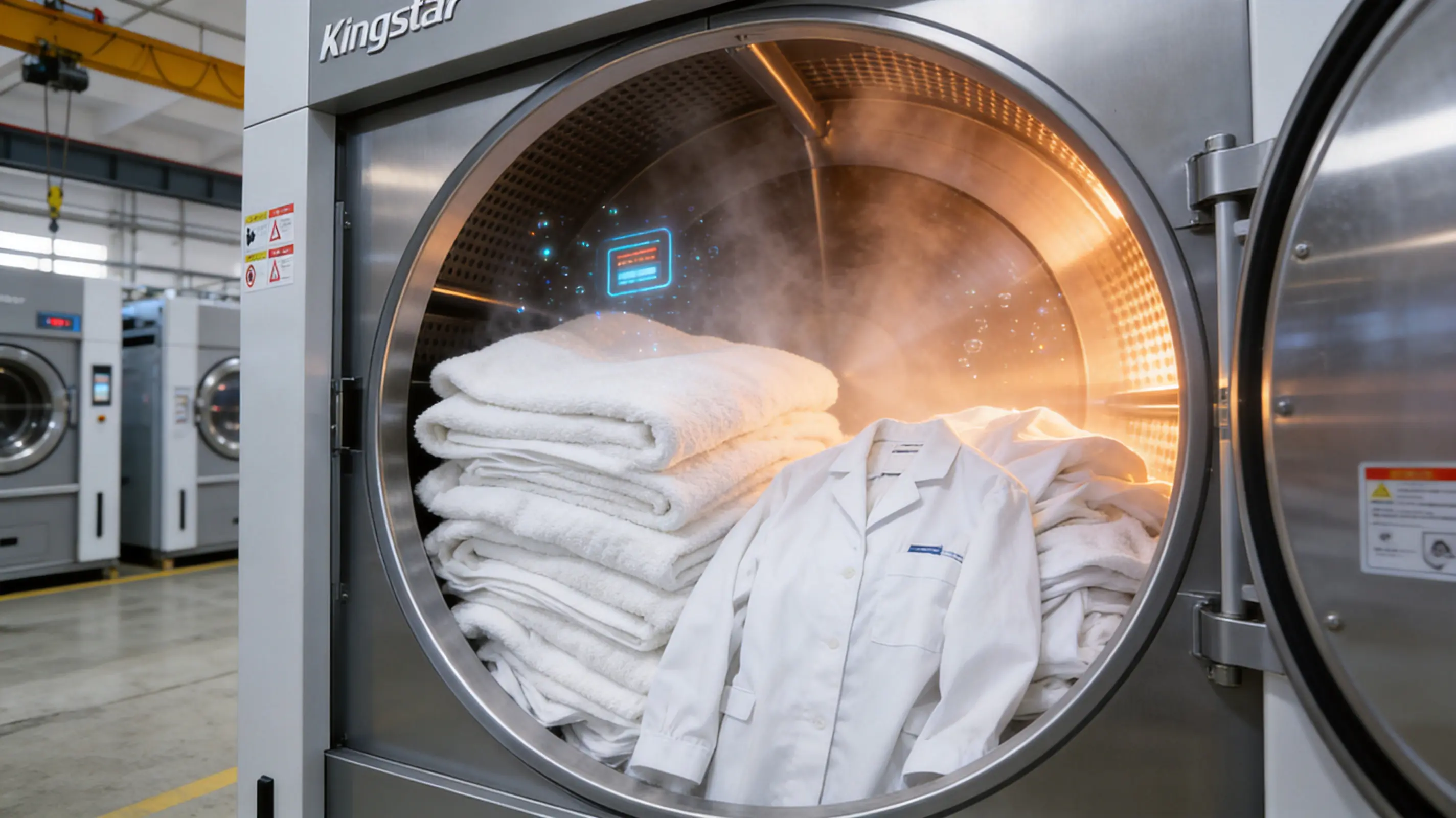
15. Recommended Operating Procedure
Before Loading
Inspect the drum, door seal, lint filter, airflow path, and surrounding area. Confirm that the machine is clean and that no foreign objects are present. Check that the selected textile load is suitable for tumble drying.
Sorting the Laundry
Separate textiles by material, weight, color, size, and care requirement. Avoid combining very heavy items with delicate or lightweight articles unless the selected program is appropriate for all items in the load.
Loading the Drum
Load the dryer evenly without exceeding the recommended capacity. Do not compress the laundry excessively. Adequate space is needed for tumbling and airflow.
Selecting the Program
Choose the drying parameters according to the textile type and required final condition. Use lower-intensity settings for heat-sensitive items and more intensive settings for heavy cotton textiles when permitted by their care instructions.
Monitoring the Cycle
Observe machine status, heating behavior, airflow, and unusual noise or vibration. The humidity verification and time-control functions should support the selected program, but operators should remain attentive to abnormal conditions.
Unloading and Inspection
When the cycle is complete, remove the load promptly. Check for damp areas, excessive dryness, wrinkles, or signs that the program requires adjustment. Record useful operating information for future loads.
After the Cycle
Clean the lint filter and inspect the drum area. Keep the machine and surrounding floor free from accumulated lint and textile debris. Routine cleaning supports airflow, safety, and consistent results.
16. Maintenance Strategy
A preventive maintenance plan helps protect production continuity. Daily checks should include the door, drum, filter, control display, unusual sounds, and visible leaks or steam abnormalities. Weekly or scheduled checks may include motor condition, belts or drive components where applicable, electrical connections, airflow passages, and steam-system components.
Maintenance intervals should be adapted to operating hours, load type, environment, and manufacturer recommendations. Facilities processing dusty textiles or large quantities of lint may require more frequent cleaning than facilities processing lighter materials.
Replacement parts should be selected according to the correct model and specification. Using unsuitable components can affect safety, performance, and warranty conditions. Maintenance staff should record inspections, repairs, replaced parts, and recurring problems to identify trends before they become major failures.
Staff should never bypass safety devices or open service areas while the machine is energized. Steam, heat, rotating components, electrical power, and stored mechanical energy can create serious hazards. Service work should be performed by trained personnel following appropriate lockout and isolation procedures.
17. Purchasing Considerations for Professional Buyers
When comparing high-capacity dryers, buyers should examine more than the nominal load rating. Important questions include the heating method, drum volume, airflow design, control functions, moisture-management system, electrical requirements, steam conditions, installation dimensions, maintenance access, spare-parts support, and expected production schedule.
The 100kg Single Tumble Dryer is especially suitable for buyers who value large-batch processing, steam heating, intelligent drying control, and integration into a broader industrial laundry system.
Buyers should also consider the relationship between the dryer and existing washers. If the laundry has several high-capacity washer-extractors, a 100kg dryer may provide a suitable balance between washing and drying capacity. If the washing department is smaller, the buyer should evaluate whether the dryer will be consistently utilized.
Facility layout is another major consideration. The machine should be positioned to minimize unnecessary movement between washing, drying, finishing, and storage. A logical layout can reduce labor time and improve safety by separating wet textile handling from dry textile handling.
Customization may be important for international customers. Electrical standards, language requirements, control preferences, loading arrangements, packaging, documentation, and site-specific utility conditions should be discussed before production. OEM and ODM capabilities can help adapt equipment and commercial arrangements to different markets.
18. Frequently Asked Questions
What is the capacity of the dryer?
The nominal capacity is 100 kilograms. Actual loading should be determined according to textile type, moisture content, bulk density, and the recommended operating range. Heavy or bulky items may require a lower practical load than lightweight textiles.
What heating method does the machine use?
The dryer uses steam heating. The listed steam pressure is 0.6MPa. Installation must follow approved technical requirements and local safety regulations.
What is the drum volume?
The drum volume is 2,000 liters. The drum diameter is 1,460 millimeters, and the drum depth is 1,200 millimeters.
How does humidity verification help?
Humidity verification helps monitor moisture conditions during drying. It supports better decisions about when the load has reached the required dryness level, helping reduce over-drying and unnecessary cycle time.
Can the dryer process different kinds of textiles?
Yes. It can be used for towels, sheets, uniforms, hospital textiles, workwear, table linens, and other suitable washable materials. Operators should sort loads and select programs according to textile care requirements.
Is the dryer suitable for hotels?
Yes. Its high capacity and programmable operation are suitable for hotel laundries that process large quantities of towels, bedding, uniforms, and other guest-service textiles.
Is it suitable for hospitals?
It can be used in hospital laundry operations for suitable healthcare textiles. Hospitals should establish their own validated hygiene, washing, drying, handling, and storage procedures in accordance with applicable regulations.
What electrical supply is listed?
The listed voltage is 380V. Buyers should confirm the required phase, frequency, current, control voltage, and local electrical standards before ordering and installation.
What are the machine dimensions?
The listed dimensions are approximately 1,638 millimeters wide, 2,100 millimeters deep, and 2,630 millimeters high. Installation clearance and maintenance access require additional space.
How heavy is the machine?
The approximate machine weight is 2,300 kilograms. The floor, delivery route, lifting equipment, and installation plan should be checked before shipment.
Does the dryer require an exhaust system?
Professional tumble dryers require suitable airflow and exhaust arrangements. The final ducting design should be determined according to the facility layout, local requirements, and the machine’s technical documentation.
Can the machine reduce energy consumption?
Humidity verification and intelligent time control are designed to help reduce unnecessary drying. Energy performance also depends on extraction efficiency, load size, textile sorting, steam quality, filter cleaning, exhaust design, and operating practices.
How should the dryer be maintained?
Operators should clean lint filters, inspect the drum and door seal, maintain airflow passages, check steam and condensate components, monitor drive operation, and follow a preventive maintenance schedule. Service work should be completed by trained personnel.
Can the manufacturer provide customized solutions?
The company provides OEM and ODM-oriented services. Buyers should discuss electrical specifications, control requirements, documentation, configuration, branding, packaging, and installation conditions before production.
19. Why This Dryer Is a Practical Long-Term Investment
A high-capacity dryer should be evaluated according to its long-term contribution to the laundry operation. The investment is not limited to the purchase price. It also affects labor utilization, processing speed, energy consumption, textile life, maintenance requirements, and customer service performance.
The 100kg Single Tumble Dryer addresses these factors through a combination of large capacity, intelligent moisture management, programmable drying, steam heating, substantial airflow power, and industrial-scale construction.
Its large drum helps reduce repeated cycles and manual handling. Its humidity verification technology supports more accurate drying decisions. Its intelligent time control helps prevent unnecessary operation. Its steam heating makes it suitable for facilities with central steam systems. Its control design supports repeatable programs across different textile categories.
The machine also benefits from being part of a broader laundry-equipment product portfolio. Customers can discuss complete laundry-line planning, equipment matching, and application requirements with a supplier experienced in industrial washing and drying machinery.
20. Conclusion
The 100kg Single Tumble Dryer is designed for laundry operations that require high throughput, reliable drying, practical controls, and better management of energy and textile quality. With a 2,000-liter drum, 100kg nominal capacity, 1,460-millimeter drum diameter, steam heating, 5.5kW air motor, 2.2kW main motor, and intelligent humidity and time-control functions, it provides a comprehensive solution for professional drying applications.
Its strongest advantages are its ability to handle large loads, support consistent drying, reduce over-drying, and integrate with commercial steam infrastructure. These features make it suitable for hotels, hospitals, commercial laundries, dry cleaners, self-service facilities, and institutional laundry departments.
Successful operation depends on more than the dryer itself. Correct installation, suitable steam and electrical services, effective extraction, proper loading, regular cleaning, staff training, and preventive maintenance are all essential. When these factors are managed together, the dryer can contribute to a more efficient, reliable, and organized laundry workflow.
For buyers seeking a high-capacity industrial dryer, this model offers a balanced combination of performance, intelligent control, fabric-care support, and production flexibility. Its engineering approach and manufacturer’s focus on commercial laundry machinery provide a strong foundation for demanding professional applications.
References
1. Product technical information for the SDR-2100 100kg Single Tumble Dryer.
2. Commercial laundry equipment operating and maintenance principles.
3. Industrial textile drying and moisture-control practices.
4. Steam-heating system design and condensate-management principles.
5. Professional laundry workflow, textile handling, and preventive-maintenance guidance.
Product: 100kg Single Tumble Dryer

ADD:No.388 Xinggang Road, Chongchuan District, Nantong City, 226000, Jiangsu Province, China.
-
Phone: +86-13917089379
-
Tel:+86-13917089379
-
Fax:+86-0513-85663366
-
E-mail:louislu@kingstarlaundry.com
products