英语
英语 俄语
俄语 西班牙语
西班牙语 德语
德语
Home / Author / Yutong Cai — Customer Solutions Specialist / 100kg Industrial Heavy Duty Washer Extractor: Performance, Efficiency, and Custom Laundry Processing

Kingstar is your trusted partner for industrial and commercial laundry equipment. We specialized in the R&D and manufacturing of high-end industrial washers, commercial washers and dryers. Meanwhile, we provide global clients with comprehensive planning, layout workflow design, and software-hardware integration services for smart laundry plants.
Yutong Cai — Customer Solutions Specialist
Aug 25,2026
100kg Industrial Heavy Duty Washer Extractor: Performance, Efficiency, and Custom Laundry Processing
Industrial laundry operations require equipment that can process large volumes of textiles reliably, safely, and consistently. A 100kg industrial heavy duty washer extractor is designed for demanding environments where washing quality, extraction performance, operating stability, and production efficiency are essential. With a rated capacity of 100kg, a 1000-liter drum volume, a maximum speed of 745 rpm, and a 400 G extraction factor, this type of machine provides a practical solution for hotels, hospitals, textile rental companies, industrial laundries, uniform services, and other high-throughput applications.
Unlike ordinary commercial washing machines, an industrial washer extractor must withstand continuous use, heavy textile loads, frequent wash cycles, and challenging operating conditions. It must also provide accurate control over water, steam, chemicals, temperature, washing time, and extraction speed. The SHS-2100T 100kg industrial heavy duty washer extractor is developed around these requirements, combining a large-capacity washing chamber with powerful extraction performance and configurable operating programs.
Another important advantage is flexibility. Different customers process different textile types, including hotel linen, hospital bedding, workwear, towels, tablecloths, uniforms, and industrial fabrics. Their utility conditions may also vary according to local electrical standards, steam systems, water pressure, drainage design, and production workflows. The equipment can therefore be customized according to customer requirements, including color, voltage, and washing programs. This approach helps laundries obtain equipment that is better aligned with their actual production conditions rather than being forced to adapt their entire operation to a standard machine.
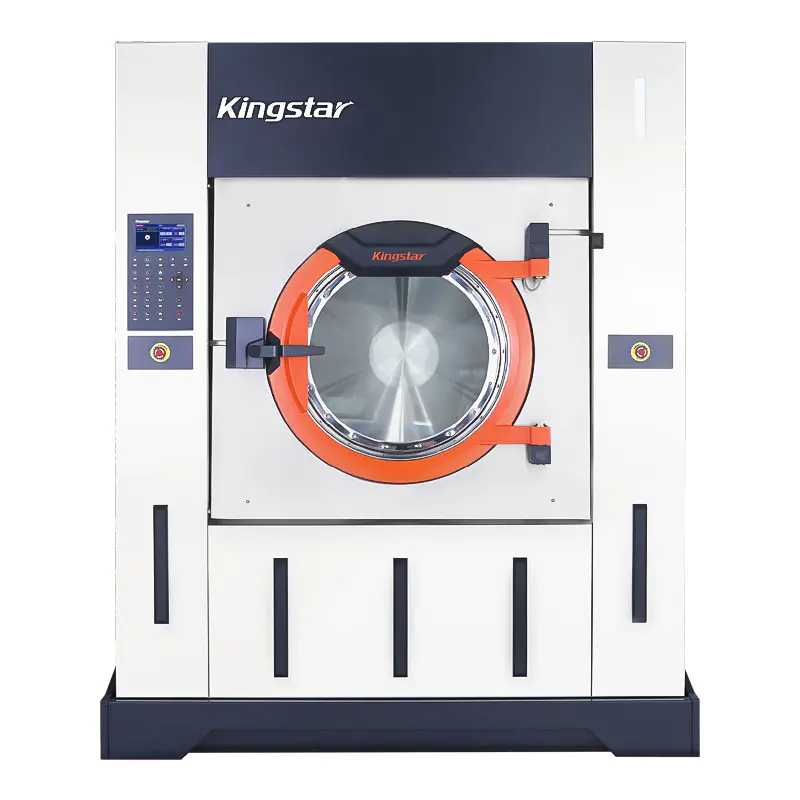
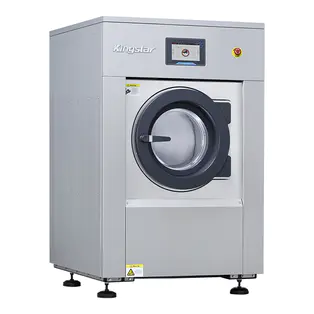
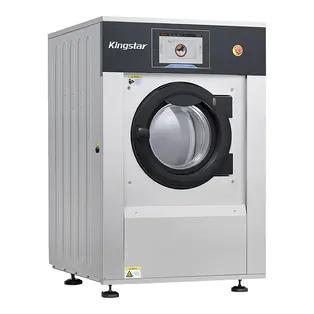
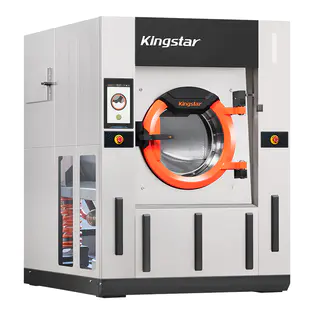
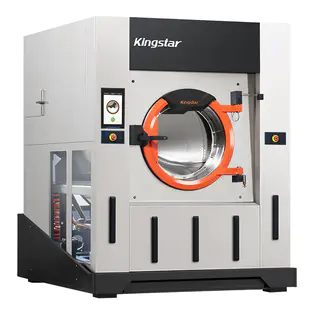
100kg Industrial Heavy Duty Washer Extractor
What Is a 100kg Industrial Washer Extractor?
A washer extractor combines two primary functions in one machine: textile washing and high-speed moisture extraction. During the washing phase, the machine uses water, heat, detergent, mechanical action, and programmed time to remove soil and contaminants from textiles. During the extraction phase, the drum rotates at high speed to separate water from the washed load before drying or finishing.
The 100kg designation refers to the machine’s nominal dry textile capacity. In practical operation, the recommended loading weight may vary depending on textile type, fabric density, moisture absorption, and the selected washing program. Lightweight sheets and garments may occupy a different drum volume from dense towels or industrial workwear. Correct loading is important because it allows textiles to move freely, supports even chemical distribution, and improves the final washing result.
The machine’s 1000-liter volume provides the internal space required for a substantial load while maintaining sufficient movement during washing. The drum diameter is 1310mm, and the drum depth is 750mm. These dimensions create a large working chamber suitable for industrial textiles while supporting an effective balance between mechanical action and load distribution.
After washing, the drum can reach a maximum speed of 745 rpm. This high-speed phase reduces the amount of residual moisture in the textiles. A lower moisture content allows downstream dryers to complete their work more quickly, reducing drying time and improving the overall productivity of the laundry line. The specified G factor of 400 indicates strong centrifugal extraction performance for a machine in this capacity class.
Key Technical Specifications
The following table summarizes the principal specifications of the 100kg industrial heavy duty washer extractor.
| Specification | Value |
|---|---|
| Model | SHS-2100T |
| Rated capacity | 100kg |
| Drum volume | 1000L |
| Voltage | 380V |
| Maximum speed | 745 rpm |
| Motor power | 15kW |
| Extraction factor | 400 G |
| Steam pressure | 0.4–0.6MPa |
| Water inlet pressure | 0.2–0.4MPa |
| Noise level | ≤70dB |
| Steam pipe connection | DN25 |
| Water inlet pipe connection | DN50 |
| Hot water pipe connection | DN50 |
| Drain pipe connection | DN110 |
| Drum diameter | 1310mm |
| Drum depth | 750mm |
| Tilting angle | 15 degrees |
| Approximate weight | 3690kg |
| Overall dimensions | 1900 × 1850 × 2350mm |
The specifications show that the machine is designed for substantial industrial installation rather than light-duty commercial use. Its 380V electrical configuration, 15kW power rating, high-capacity utility connections, and approximately 3690kg structural weight are consistent with a machine intended to operate as part of a professional laundry production system.
Large Capacity for Industrial Laundry Production
One of the clearest advantages of a 100kg washer extractor is its ability to process a large quantity of textiles per cycle. A laundry that uses several small machines may need additional labor, more floor space, more loading and unloading operations, and more time to complete the same volume. A larger machine can simplify production planning by consolidating more textiles into fewer cycles.
Large capacity is particularly valuable for facilities that handle regular batches of similar textiles. Hotel laundries may wash bed linen, pillowcases, towels, and bathrobes in separate or sequential programs. Hospitals may process bedding, patient garments, uniforms, and reusable protective textiles. Industrial laundries may handle workwear, rental linen, cleaning cloths, and specialized fabrics. In each case, a 100kg machine can help reduce the number of cycles required during a working shift.
Capacity alone, however, is not enough. A large drum must provide effective textile movement. If the load is too tightly packed, water and chemicals may not circulate properly. The 1000-liter drum volume is therefore important because it supports the movement of the load during washing and rinsing. Proper loading practices remain necessary, but the machine’s drum size provides an appropriate working environment for a 100kg industrial batch.
High capacity can also improve labor efficiency. Operators spend less time repeatedly weighing, loading, unloading, and starting smaller machines. When production procedures are standardized, the larger washer extractor can support a more predictable workflow. This is especially useful in centralized laundries that organize production by textile category, soil level, customer order, or delivery schedule.
High-Speed Extraction and Lower Residual Moisture
Extraction performance strongly affects the cost and speed of the complete laundry process. Textiles that leave the washer with excessive residual water require more time and energy in the dryer. A washer extractor with a maximum speed of 745 rpm and a 400 G extraction factor is designed to remove a substantial portion of free water before drying.
The benefits of effective extraction extend beyond dryer operating time. Reduced residual moisture can help increase dryer throughput, shorten finishing schedules, and improve the handling of linen before ironing or folding. In a large laundry, even a small reduction in moisture per batch can produce meaningful operational benefits over hundreds of cycles.
The 400 G extraction factor represents the centrifugal force generated during high-speed spinning. The actual result depends on textile type, load distribution, program settings, and mechanical condition. Dense materials, towels, and heavy workwear may retain more moisture than lightweight sheets. Nevertheless, a high extraction factor provides a strong technical foundation for reducing moisture across a wide range of industrial laundry loads.
High-speed extraction also supports better production coordination. When the washer extractor removes more water, the downstream dryer can process loads more efficiently. This helps prevent a common bottleneck in laundry facilities, where the washer completes its cycle faster than the dryer can handle wet textiles. Balancing washing, extraction, drying, and finishing capacity is essential for maintaining consistent daily output.
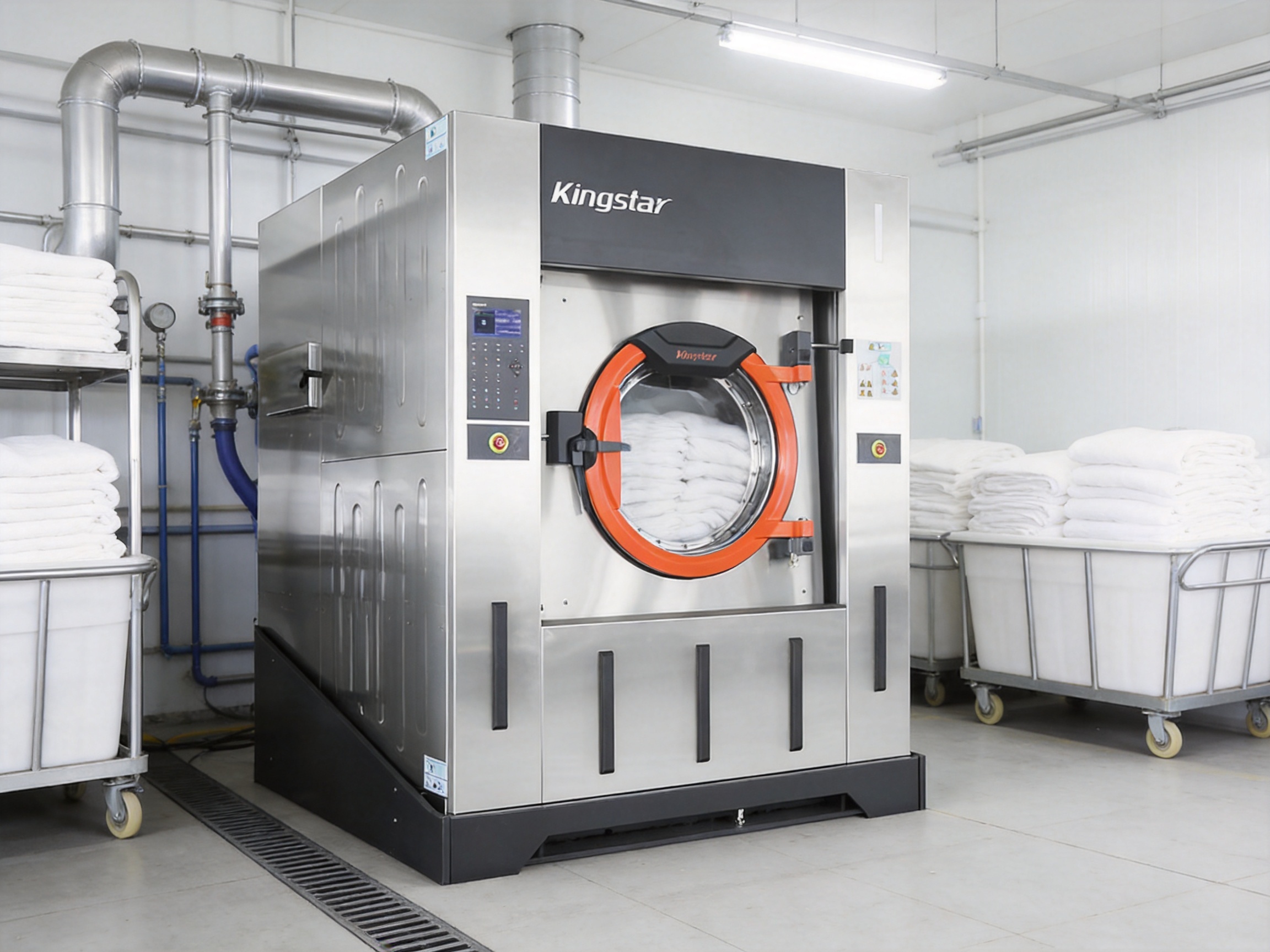
Stable Industrial Construction
Industrial laundry equipment must tolerate repeated mechanical stress. During washing and extraction, the drum, drive system, frame, bearings, and supporting structure experience dynamic forces. The approximately 3690kg machine weight contributes to stability and helps the equipment remain firmly positioned during operation.
A stable machine foundation is especially important during high-speed extraction. Proper installation on a suitable industrial floor, accurate leveling, and correct connection to utilities are essential for safe and efficient operation. The machine’s industrial configuration is intended to support continuous production environments where reliability is more important than the compact design typically associated with household or small commercial machines.
Industrial construction also influences service life. A machine that is correctly loaded, installed, maintained, and operated according to its specifications can provide dependable performance over an extended working period. Operators should follow recommended maintenance schedules for bearings, drive components, seals, valves, water connections, steam connections, and electrical systems.
The 15kW power rating provides the drive system with the capacity required for a large textile load. Motor power must be considered together with drum size, load distribution, acceleration, extraction speed, and control logic. A suitable industrial drive system allows the machine to move from low-speed washing to high-speed extraction in a controlled manner.
Configurable Washing Programs
Different textiles require different treatment. A hospital linen load may require a hygiene-focused program with controlled temperature, rinsing, and chemical dosing. Hotel towels may require strong mechanical action and sufficient rinsing. Delicate garments may need lower mechanical intensity, while heavily soiled workwear may require a longer wash period, higher temperature, or additional chemical stages.
The machine can be configured with suitable programs according to customer requirements. This is a major advantage over equipment that provides only a fixed set of generic cycles. Program customization allows the operation to define washing procedures based on textile categories, soil levels, water conditions, chemical systems, and customer quality standards.
A customized program may include several stages, such as prewash, main wash, intermediate drain, multiple rinses, chemical dosing, high-temperature treatment, and extraction. The exact design should be determined by the textile application and the laundry’s process requirements. A professional supplier can work with the customer to establish appropriate cycle structures before production or commissioning.
Program flexibility can also improve process consistency. When operators use a defined program for a specific textile category, the results are less dependent on individual judgment. Standardized programs help reduce variations in washing time, water use, chemical dosage, and extraction performance. This is valuable for commercial laundries that must deliver repeatable results to multiple customers.
Customization may include not only the sequence of washing stages but also the operating parameters within each stage. These may include water level, washing duration, drum speed, temperature, extraction duration, and rinse count. Actual parameters should be validated with textile manufacturers, chemical suppliers, and the laundry’s quality-control procedures.
Steam and Water Utility Compatibility
Steam can provide efficient heating for industrial washing operations. The specified steam pressure range is 0.4–0.6MPa, with a DN25 steam pipe connection. This configuration is suitable for facilities that use a central boiler or industrial steam network, subject to verification by qualified installation personnel.
Steam heating can offer rapid temperature response and may integrate efficiently with an existing laundry utility system. It can be particularly useful in facilities that already use steam for dryers, presses, finishing equipment, or other production machinery. Centralized steam generation may also simplify energy management across the laundry.
The machine includes a water inlet pressure range of 0.2–0.4MPa and a DN50 water inlet connection. The hot water pipe connection is also DN50. These connections are designed for substantial water flow, which is important when filling and rinsing a 1000-liter drum. The actual facility supply should be checked before installation to ensure that pressure, flow, water quality, and temperature meet the requirements of the selected process.
Drainage is another critical consideration. The specified drain pipe connection is DN110, supporting the removal of used wash water from a large-capacity machine. An appropriately designed drainage system should accommodate the flow rate, water temperature, detergent content, and discharge requirements of the facility. Drainage should be installed to minimize backflow, standing water, and unnecessary restrictions.
Industrial laundries should also consider water treatment. Water hardness, mineral content, iron, suspended solids, and other characteristics can affect washing performance, textile appearance, heating efficiency, and machine maintenance. Where necessary, filtration, softening, or other treatment systems can be incorporated into the laundry’s utility design.
Noise and Working Environment
The specified noise level is no more than 70dB. Maintaining a controlled noise environment is beneficial for operator comfort, workplace communication, and the overall working conditions of the laundry. Noise performance depends on installation quality, floor condition, load balance, machine maintenance, and the surrounding building structure.
Operators should avoid overloading or underloading the machine because an improperly balanced load can create vibration and additional noise during extraction. Correct distribution of textiles inside the drum supports smooth acceleration and stable high-speed operation. If unusual vibration or noise occurs, the machine should be inspected rather than operated continuously under abnormal conditions.
Noise control is also relevant for laundries located near hospitals, hotels, residential buildings, or customer-facing areas. A machine with a controlled operating noise level can be easier to integrate into a professional facility, although the complete acoustic environment depends on the room, wall construction, ventilation system, and other equipment.
Tilting Function for Handling Efficiency
The machine is specified with a 15-degree tilting angle. A tilting structure can assist with loading and unloading by changing the drum position and helping textiles move toward the access area. This can be particularly useful when handling large, wet, or heavy textile loads that would otherwise require more manual effort.
Ergonomics are important in industrial laundry design. Repetitive lifting and pulling can contribute to operator fatigue, especially when wet textiles are involved. A suitable tilting function can support more convenient material handling and help reduce the physical strain associated with removing a large batch from the drum.
The practical value of tilting depends on the complete installation layout, loading height, trolley position, operator access, and workflow design. The machine should be positioned so that carts, bins, and transfer equipment can be placed close to the loading and unloading points without obstructing maintenance access or safety zones.
Efficient unloading also improves production rhythm. When an operator can remove a batch quickly and safely, the next production cycle can begin sooner. In a high-volume laundry, small improvements in loading and unloading time can accumulate into significant daily capacity gains.
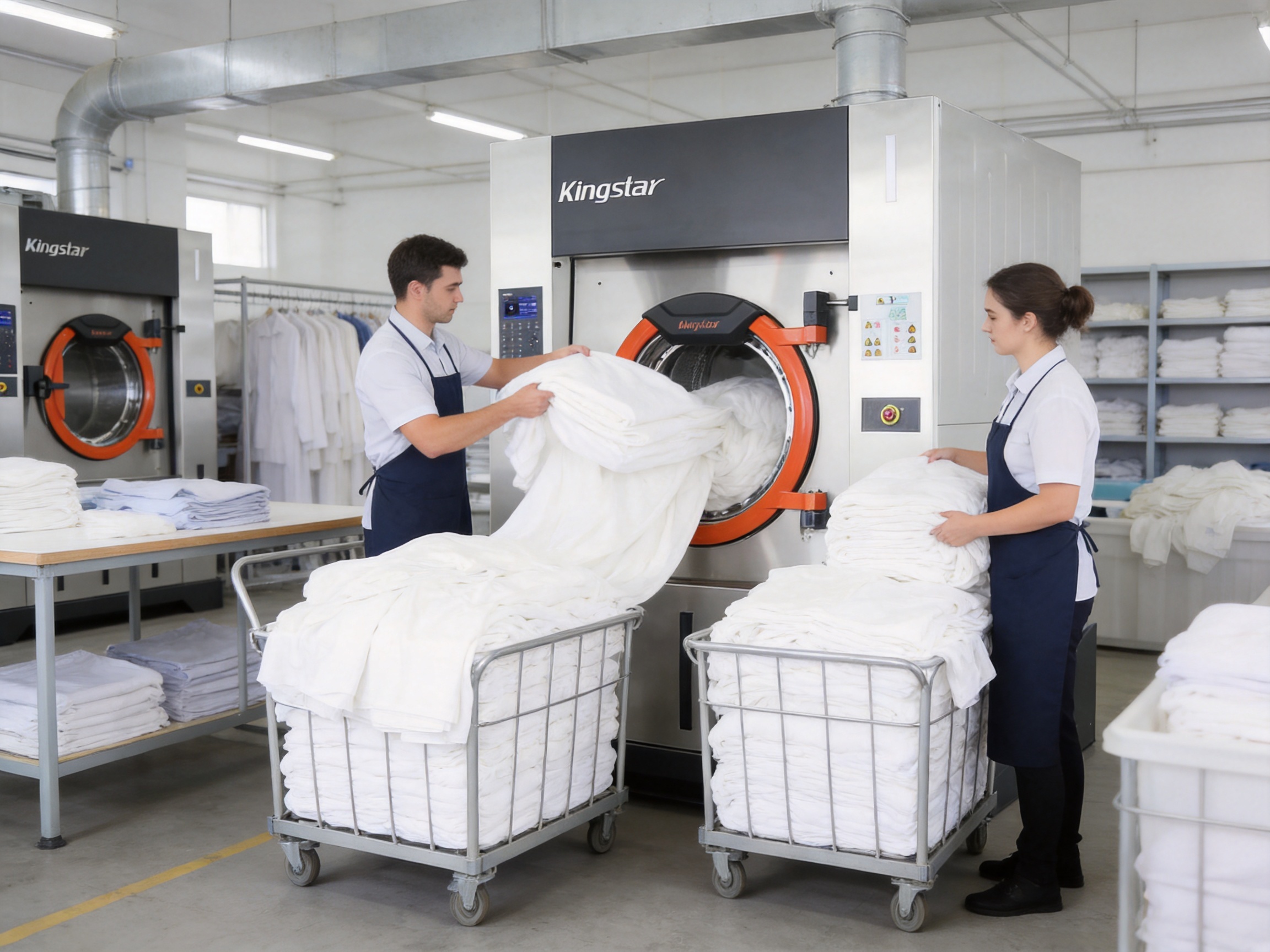
Advantages Over Smaller or Less Specialized Machines
Higher Throughput
A 100kg industrial washer extractor can process a much larger batch than a typical small commercial washer. This makes it suitable for centralized laundry operations and large institutional facilities. Fewer cycles can mean fewer loading operations, less operator movement, and more consistent production planning.
Integrated Washing and Extraction
Because washing and extraction occur in the same machine, textiles do not need to be transferred between separate washing and spinning units. This reduces handling, saves floor space, and limits the risk of delays between process stages. Integrated operation can also reduce the chance of textile mix-ups or contamination during transfer.
Strong Moisture Removal
The 745 rpm maximum speed and 400 G extraction factor provide a strong basis for removing water before drying. Compared with low-speed washing equipment, a high-extraction machine can reduce the burden on dryers and support better overall energy efficiency.
Industrial Utility Connections
The DN25 steam connection, DN50 water and hot water connections, and DN110 drain connection are designed for integration into industrial utility systems. These larger connections support the flow requirements of a high-capacity washer and are more appropriate for a production laundry than domestic-style connections.
Customizable Configuration
The ability to customize color, voltage, and washing programs gives customers more control over the final equipment configuration. This can be especially important for international installations, where electrical standards and utility conditions differ between markets.
Reduced Dependence on Manual Judgment
Customized programs can establish repeatable procedures for different textile categories. Once validated, these programs allow operators to follow a consistent process instead of manually estimating wash time, water level, or extraction settings for every batch.
Manufacturing Strengths and Production Approach
Advanced industrial equipment manufacturing requires more than assembling individual components. The complete machine must be designed as an integrated system in which the drum, frame, drive, control, utility connections, tilting mechanism, and safety features work together. A strong manufacturing process begins with understanding the application, capacity, textile types, installation environment, and customer requirements.
The manufacturer’s product approach emphasizes customized industrial laundry solutions. Customer requirements may include a specific operating voltage, preferred exterior color, special washing programs, or process functions adapted to a particular laundry application. This flexibility demonstrates an engineering-oriented production model rather than a purely standardized sales model.
Design review is an important stage in the manufacturing process. Before production, the equipment configuration should be checked against the customer’s intended capacity, utility conditions, floor plan, loading method, drainage design, and production schedule. Reviewing these factors early helps reduce installation problems and ensures that the delivered machine is appropriate for the facility.
Industrial fabrication must also address dimensional accuracy and structural consistency. The drum and supporting frame need to maintain correct alignment, while rotating components must be balanced to support stable operation. Connections for steam, water, hot water, and drainage must be positioned accurately so that the equipment can be integrated into the customer’s pipework.
Welding and structural assembly are particularly important for heavy-duty equipment. Consistent fabrication helps support the machine’s rigidity and long-term stability. The large machine weight and high-speed extraction function make it essential that the frame and supporting structure are assembled according to controlled production requirements.
Electrical and control integration is another major part of manufacturing. The motor, control system, valves, sensors, heating or steam functions, extraction sequence, and safety logic must be coordinated. A properly integrated control system allows the machine to perform different programmed stages while protecting the equipment from unsuitable operating conditions.
Factory testing should verify the essential functions before shipment. Depending on the agreed inspection plan, testing may include checks of drum rotation, program operation, valve response, water filling, drainage, extraction transition, tilting movement, electrical performance, noise behavior, and general assembly quality. Testing before delivery can help identify issues while the equipment is still at the production site.
Customization requires communication between technical personnel, production staff, and the customer. Clear confirmation of voltage, frequency, steam pressure, water pressure, pipe sizes, dimensions, color, program requirements, and installation conditions reduces the possibility of misunderstandings. This customer-focused process is a significant strength for projects that require more than a standard catalog configuration.
Quality Control Considerations
Quality control for a heavy-duty washer extractor should cover materials, fabrication, assembly, electrical systems, rotating components, utility connections, and final operation. A machine may have strong individual components, but its reliability depends on the quality of the complete system.
Dimensional checks help ensure that the delivered machine matches the approved design. This includes overall length, width, height, drum dimensions, pipe connection locations, access clearances, and tilting movement. Dimensional accuracy is especially important when the laundry has already prepared foundations, doors, service corridors, or utility routes.
Rotational testing is necessary for a high-speed washer extractor. The drum should accelerate and decelerate in a controlled manner, and the machine should operate smoothly at different speeds. Load balance, bearing condition, drive alignment, and frame stability all influence extraction performance.
Utility testing should confirm that water enters correctly, hot water and steam functions respond as intended, and drainage operates without unacceptable restriction. The facility’s actual utilities must still be verified during installation because factory conditions and customer-site conditions may differ.
Program validation helps confirm that the machine executes the intended sequence. This may include filling, washing, heating, chemical dosing, draining, rinsing, and extraction. For customized programs, the customer should review the program structure and approve the final settings based on textile performance and operational requirements.
Noise and vibration checks provide additional information about machine behavior. A result of no more than 70dB is specified, but actual operating conditions can influence the measured level. Testing should be carried out with suitable procedures, and installation should follow the recommended foundation and leveling requirements.
Applications Across Multiple Industries
Hotels and Hospitality Facilities
Hotels generate large volumes of bed linen, towels, pillowcases, bathrobes, table linen, and uniforms. These textiles often need fast turnaround because room occupancy and food service operations depend on clean supplies. A 100kg washer extractor can help centralize linen processing and reduce the number of cycles required during peak periods.
Hotels may also benefit from customized programs. Towels may need a different process from sheets, while colored uniforms and delicate decorative fabrics may require special treatment. Program separation helps protect textile quality and maintain consistent appearance.
Hospitals and Healthcare Laundries
Hospitals require carefully controlled laundry procedures. Bedding, patient garments, staff uniforms, reusable protective items, and cleaning textiles may have different processing requirements. A programmable industrial washer extractor can support standardized procedures, provided that the selected programs are validated according to applicable healthcare, infection-control, chemical, and textile-care requirements.
Healthcare laundries should also consider loading separation, clean and dirty workflow design, water quality, temperature control, chemical dosing, and operator training. The machine is one part of a broader hygienic processing system, and its benefits are maximized when the complete facility is designed around controlled material flow.
Industrial Workwear Services
Workwear and protective garments can contain oil, grease, dust, metal particles, food residue, or other difficult soils. Industrial laundries serving factories, workshops, logistics companies, and construction businesses may need strong mechanical action, suitable detergents, prewash stages, and repeatable extraction.
The large capacity of the machine supports batch processing for uniforms and work garments. Customized programs can be created for different levels of soil or different textile compositions, while high-speed extraction prepares garments for efficient drying.
Textile Rental Companies
Textile rental businesses depend on repeated processing and predictable output. Their products may include uniforms, mats, towels, table linen, cleaning cloths, and other reusable textile items. A heavy-duty washer extractor can help support the high number of cycles required by a rental operation.
Because rental textiles are processed repeatedly, the washing program must balance cleaning performance with fabric protection. Excessive mechanical action, temperature, chemical concentration, or extraction may shorten textile life. Customized programs can help the operator establish a more appropriate balance.
Commercial and Institutional Laundries
Universities, restaurants, sports facilities, cruise services, public institutions, and large residential operations may all require industrial laundry capacity. A 100kg machine can serve as a central production unit or as part of a larger group of washers and dryers.
Energy and Workflow Efficiency
Energy efficiency in laundry operations depends on the full process rather than one specification alone. Water temperature, wash duration, chemical performance, extraction speed, dryer efficiency, heat recovery, utility pressure, and operator practices all contribute to total consumption.
High-speed extraction is one of the most direct ways a washer extractor can influence downstream energy use. By removing more water before drying, the machine can reduce the amount of heat required to evaporate moisture. The effect will vary according to textile type, extraction settings, dryer design, and the selected process, but the principle is important for every large laundry.
Program customization can also support efficiency. A textile load should not be processed with a longer or hotter cycle than necessary. By defining suitable programs for different soil levels and textile categories, the laundry can avoid applying maximum treatment to every batch.
Efficient workflow design is equally important. The machine should be located near textile sorting, chemical supply, dryers, finishing equipment, and clean-linen storage according to the facility’s material flow. Shorter transfer distances can reduce labor and handling time. Adequate space around the machine is required for safe loading, unloading, inspection, and maintenance.
Production scheduling can be organized around the 100kg capacity. For example, the laundry may plan separate cycles for light-colored linen, towels, workwear, or heavily soiled textiles. This approach supports batch traceability and helps operators prepare the correct chemicals, carts, and downstream equipment before each cycle begins.
Installation Requirements
Because the washer extractor is a large industrial machine, installation should be performed by qualified personnel. The approximate dimensions are 1900 × 1850 × 2350mm, but additional clearance is required for loading, unloading, maintenance, tilting movement, ventilation, pipework, and electrical access.
The machine’s approximate weight is 3690kg. The building floor and foundation must be able to support the static and dynamic loads associated with the equipment. A structural engineer or qualified installation professional should confirm the suitability of the proposed location before delivery.
The electrical supply must match the specified voltage and the final configuration agreed with the customer. Electrical protection, grounding, disconnect devices, cable sizing, and control-system requirements should be reviewed by a qualified electrician. International projects may require voltage or frequency customization, which should be confirmed before manufacturing.
Steam and water connections should be prepared according to the equipment specifications. The steam system must provide suitable pressure and include appropriate safety and isolation components. Water supply lines should deliver adequate pressure and flow. Hot water availability should be evaluated if the laundry intends to use preheated water to reduce heating time.
Drainage must be designed to handle discharge from a large-capacity drum. The DN110 drain connection should be connected to a suitable system with appropriate slope, capacity, and access for cleaning. Poor drainage can slow cycles, create backflow, and interfere with washing performance.
Before commissioning, the installation team should check leveling, access doors, utilities, safety devices, pipe connections, electrical connections, program settings, and emergency procedures. Operators should receive training in loading, program selection, unloading, cleaning, inspection, and routine maintenance.
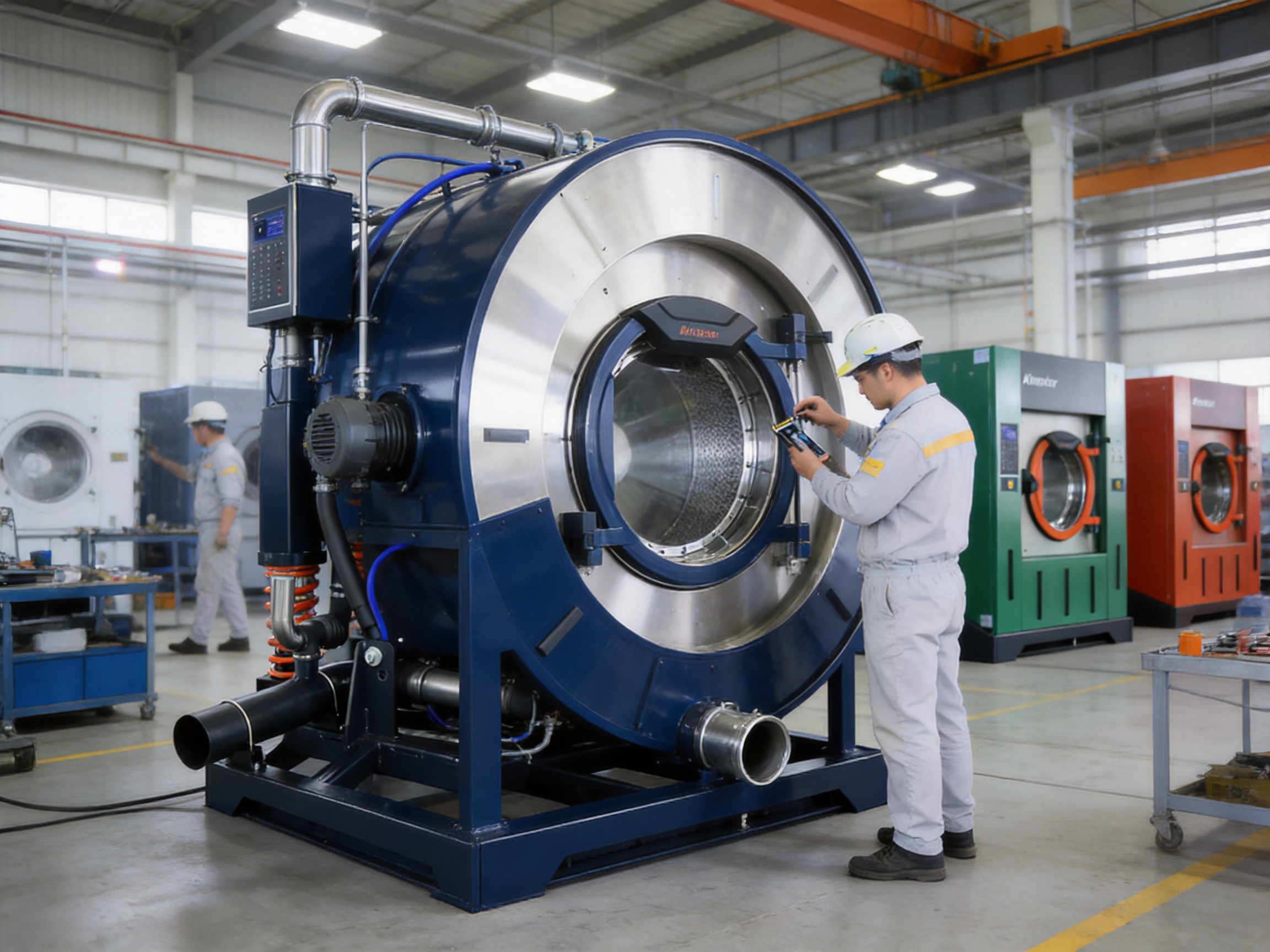
Operation and Maintenance Recommendations
Correct operation begins with sorting textiles by material, color, soil level, and processing requirements. Foreign objects should be removed from pockets and textile bundles. Loads should be weighed or estimated accurately to avoid overloading. The machine should not be used as a general-purpose container for incompatible textile categories.
Loading should be distributed as evenly as possible. Overloading can restrict textile movement, reduce washing quality, increase mechanical stress, and interfere with extraction balance. Underloading may also create imbalance during high-speed spinning, particularly when the textiles collect on one side of the drum.
Operators should select the program that matches the load. Water level, temperature, chemical dosage, washing time, rinse count, and extraction settings should be based on the validated process. Unapproved changes may affect cleaning results, textile life, energy consumption, and equipment performance.
At the end of a cycle, textiles should be unloaded promptly where possible. Leaving wet textiles inside the drum for extended periods may lead to odor, wrinkling, or microbial growth. The drum and surrounding areas should be kept clean, and the loading door or access area should be managed according to the facility’s safety procedures.
Routine maintenance should include inspection of seals, hoses, valves, pipe connections, bearings, drive components, electrical connections, safety devices, and the tilting mechanism. Any leakage, unusual noise, vibration, failure to drain, or abnormal extraction behavior should be investigated promptly.
Cleaning the machine helps protect both textile quality and equipment performance. Residual detergent, lint, soil, and mineral deposits can accumulate in the drum, drain path, seals, or pipework. The appropriate cleaning frequency depends on water quality, textile type, chemical system, and operating hours.
Preventive maintenance is generally more effective than waiting for a breakdown. Planned inspections can identify wear before it causes an unexpected stoppage. For a high-throughput laundry, preventing one major interruption may protect production schedules, customer deliveries, and labor planning.
Why Customization Matters for International Customers
Laundry facilities around the world do not share identical utility conditions. Electrical voltage, frequency, steam availability, water pressure, drainage practices, building dimensions, and climate may vary significantly. A machine configured for one market may not be suitable for another without technical adaptation.
Customization allows the equipment to be prepared for the customer’s actual installation environment. Voltage can be adjusted according to the agreed electrical specification. Exterior color can be selected to match the facility or equipment identification system. Programs can be adapted to local textile types, chemical procedures, and production requirements.
Customization can also support OEM and project-based purchasing. A distributor, laundry equipment contractor, or institutional buyer may need a specific configuration for a larger installation. Working directly with the manufacturer during the design stage can help coordinate machine capacity, utilities, process programs, documentation, and delivery requirements.
The most effective customization process is based on detailed technical communication. Customers should provide information about textile categories, daily production volume, available utilities, installation restrictions, required cycle times, target moisture levels, and downstream dryer capacity. This information enables the supplier to recommend a more appropriate configuration.
Comparison with Conventional Commercial Washers
Conventional commercial washers are useful for smaller laundries, but they may not provide the capacity or extraction force required by large institutions. A 100kg industrial machine is designed for heavier production loads and continuous industrial workflows.
Commercial machines may require several separate cycles to process the same quantity of textiles. This can increase labor input and make production more difficult to coordinate. A large washer extractor reduces the number of batches while offering a process platform that can be customized for multiple textile categories.
Another difference is utility integration. Industrial machines are commonly connected to dedicated steam, hot water, cold water, drainage, and electrical systems. This allows them to operate as part of an engineered laundry plant rather than as independent units placed in a small room.
The choice between machine sizes should be based on actual production needs. A 100kg machine is most appropriate where the facility has sufficient textile volume, utility capacity, floor area, and trained operators. For smaller operations, multiple lower-capacity machines may provide more flexibility. For high-volume operations, however, the 100kg washer extractor can offer a stronger balance of capacity, extraction, and customization.
Purchasing Checklist for Buyers
Before ordering a 100kg industrial heavy duty washer extractor, buyers should confirm the required dry textile capacity and the typical composition of each load. The capacity should be matched to daily production volume and the available number of dryers and finishing machines.
The buyer should confirm electrical requirements, including voltage, frequency, phase arrangement, connected load, and protection requirements. Steam pressure, water pressure, hot water availability, drainage capacity, and pipe connection sizes should also be documented.
Building access must be reviewed. The overall dimensions are approximately 1900 × 1850 × 2350mm, but delivery routes, doorways, elevators, ramps, ceiling height, and final positioning should be checked carefully. The equipment’s approximate 3690kg weight may require specialized transport and lifting arrangements.
Program requirements should be discussed in detail. Buyers should identify the textiles to be processed, soil levels, preferred temperatures, chemical stages, rinse requirements, extraction targets, and any special hygiene or textile-care procedures. These details can be used to prepare suitable programs before commissioning.
After-sales support should also be considered. Buyers should ask about operating manuals, installation guidance, spare parts, maintenance procedures, technical training, warranty conditions, and response arrangements. Reliable support helps protect the long-term value of the equipment.
Frequently Asked Questions
What is the rated capacity of this industrial washer extractor?
The rated capacity is 100kg of dry textiles per load. The correct practical loading weight may vary according to textile density, moisture absorption, and the selected washing process.
What is the drum volume?
The drum volume is 1000 liters. The drum diameter is 1310mm, and the drum depth is 750mm.
What is the maximum extraction speed?
The maximum speed is 745 rpm. The specified extraction factor is 400 G, which supports strong moisture removal before drying.
What voltage does the machine use?
The listed configuration uses 380V. Voltage and other electrical details can be discussed for customer-specific requirements before production.
Can the washing programs be customized?
Yes. Suitable programs can be designed according to the customer’s textile types, soil levels, chemical procedures, temperature requirements, rinse stages, and production workflow.
Can the exterior color be customized?
Color customization can be arranged according to customer requirements. The final color should be confirmed during the technical and commercial specification stage.
What steam pressure is required?
The specified steam pressure range is 0.4–0.6MPa, with a DN25 steam pipe connection. The customer’s steam system should be checked by qualified personnel before installation.
What water pressure is required?
The specified water inlet pressure is 0.2–0.4MPa. The machine uses a DN50 water inlet connection and a DN50 hot water connection.
What size is the drain connection?
The specified drain pipe connection is DN110. The facility drainage system should be designed to handle the flow and discharge requirements of a 1000-liter industrial drum.
How quiet is the machine?
The specified noise level is no more than 70dB. Actual noise and vibration can also be affected by foundation quality, leveling, load distribution, maintenance, and the surrounding building.
Does the machine include a tilting function?
Yes. The listed tilting angle is 15 degrees. Tilting can assist with loading and unloading large textile batches when the machine is installed with a suitable handling layout.
What types of businesses can use this machine?
Potential applications include industrial laundries, hotels, hospitals, textile rental services, uniform processing companies, restaurants, institutions, sports facilities, and other organizations that process large volumes of textiles.
How does high extraction speed help the laundry?
High-speed extraction removes more water before drying. This can reduce dryer workload, shorten drying time, improve production flow, and potentially reduce energy consumption.
What should be considered before installation?
Buyers should confirm floor strength, dimensions, access routes, electrical supply, steam pressure, water pressure, hot water supply, drainage, ventilation, loading space, unloading space, and maintenance clearances.
Why is operator training important?
Training helps operators select suitable programs, load the drum correctly, recognize abnormal vibration or noise, follow safety procedures, clean the machine, and report maintenance issues before they become serious problems.
Conclusion
The 100kg industrial heavy duty washer extractor is designed for professional laundry facilities that need substantial capacity, effective extraction, configurable programs, and dependable integration with industrial utilities. Its 1000-liter drum, 745 rpm maximum speed, 400 G extraction factor, 15kW power rating, controlled noise specification, and 15-degree tilting function provide a practical foundation for high-volume textile processing.
Its advantages are not limited to capacity. The equipment can be adapted to customer requirements through customized voltage, color, and washing programs. This flexibility makes it suitable for different international markets and diverse laundry applications. By combining washing and extraction in one industrial machine, it can reduce textile handling, improve workflow, and support more efficient use of downstream drying equipment.
The manufacturing strength behind a machine of this type depends on integrated design, controlled fabrication, accurate assembly, utility compatibility, functional testing, and clear communication with the customer. A professional supplier that can support customized engineering and application-specific programs provides added value beyond the physical machine itself.
For laundries processing large volumes of hotel linen, hospital textiles, workwear, rental garments, towels, uniforms, or institutional fabrics, the 100kg washer extractor can serve as a central production asset. Proper installation, validated programs, correct loading, operator training, and preventive maintenance will help the equipment deliver stable performance throughout its service life.
References
1. Industrial Laundry Equipment Design and Operation Principles, technical reference publication.
2. Commercial and Industrial Textile Care Procedures, laundry process management reference.
3. Centrifugal Extraction and Residual Moisture Control in Textile Processing, engineering reference.
4. Steam, Water, and Drainage Utility Planning for Industrial Laundry Facilities, installation planning reference.
5. Preventive Maintenance Practices for Heavy-Duty Washing Machinery, equipment maintenance reference.
6. Textile Classification, Washing Chemistry, and Program Development Guidelines, professional laundry reference.
Product: 100kg Industrial Heavy Duty Washer Extractor

ADD:No.388 Xinggang Road, Chongchuan District, Nantong City, 226000, Jiangsu Province, China.
-
Phone: +86-13917089379
-
Tel:+86-13917089379
-
Fax:+86-0513-85663366
-
E-mail:louislu@kingstarlaundry.com
products